
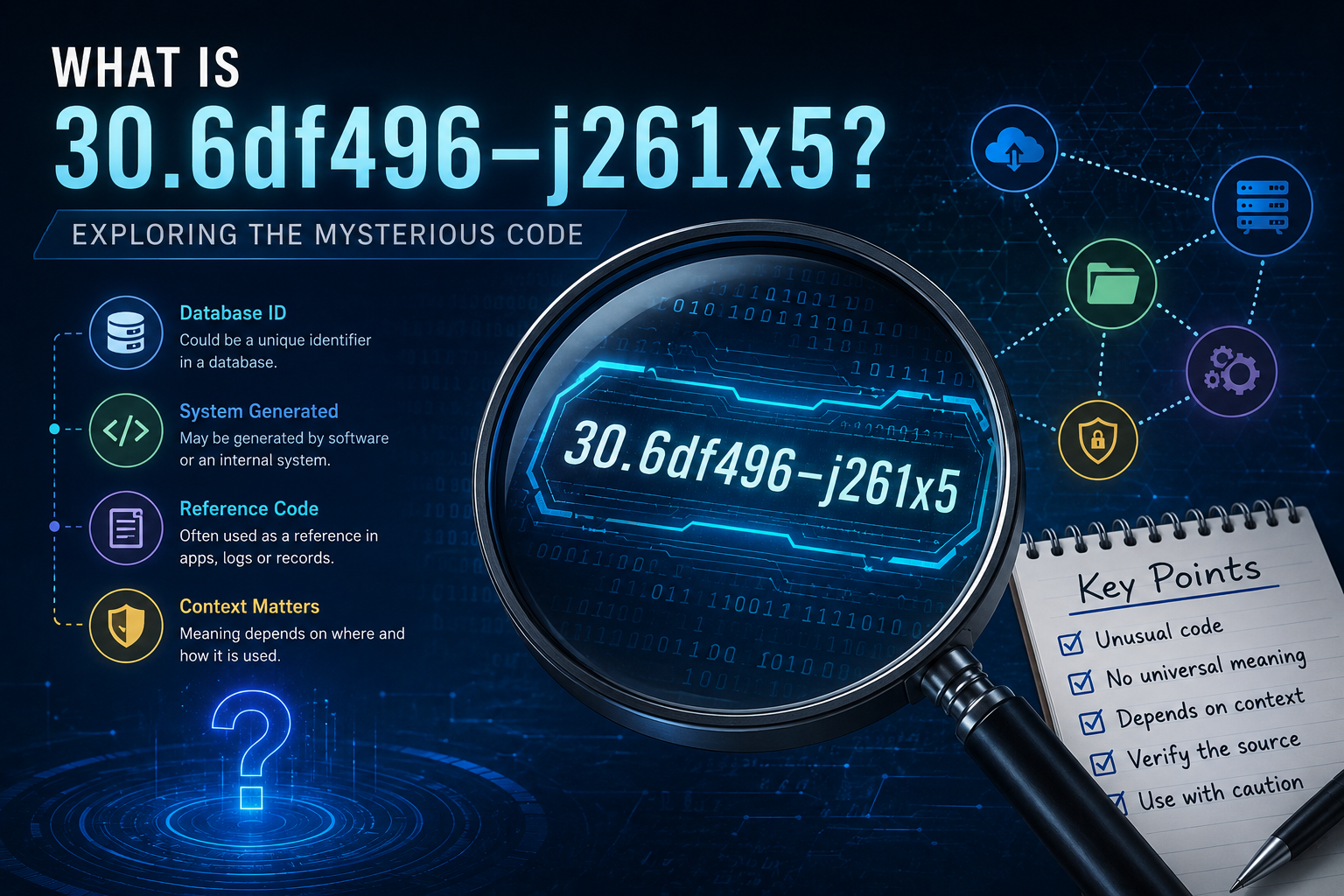
If you have recently searched for what is 30.6df496–j261x5, you may have noticed that the phrase looks completely different from an ordinary word, product name, or familiar technical abbreviation. It contains numbers, letters, a decimal point, and a separator, which gives it the appearance of a computer-generated identifier.
The question of what is 30.6df496–j261x5 does not have one universally confirmed answer. Based on the available information, the string appears more like an identifier or reference code than a recognized product, organization, technology, or standard.
That distinction is important because unusual codes can appear in many different environments. They may come from software, databases, websites, product systems, automated pages, error messages, or internal records.
This guide takes a practical approach to what is 30.6df496–j261x5, explaining its structure, possible uses, online appearance, security concerns, and the best ways to investigate it without making unsupported assumptions.
What Is 30.6df496–j261x5 Really?
When people ask what is 30.6df496–j261x5, the first thing to understand is that the phrase does not currently have a publicly verified universal definition.
The unusual combination of characters makes it look like a generated reference.
Why Does the String Look Technical?
The identifier can be separated into several visible components:
- 30 — numerical section
- . — decimal separator
- 6df496 — mixed alphanumeric sequence
- – — separator
- j261x5 — letters and numbers
This structure is unlike a normal English word.
It resembles formats that can be generated by computer systems, websites, databases, and automated services. However, appearance alone cannot prove which system created it.
That is why what is 30.6df496–j261x5 should be answered through context rather than by simply decoding each individual character.
7 Possible Reasons You May Encounter the Code
There are several situations that can explain why someone searches what is 30.6df496–j261x5.
1. Database Identification
Databases often assign unique values to records.
A record may have a complicated identifier that is meaningful to the software but meaningless to an ordinary visitor.
For example, a database could use a random-looking string to distinguish one entry from thousands of others.
2. Software-Generated Reference
Applications frequently generate identifiers for files, sessions, transactions, objects, or internal processes.
If the code appeared inside software, it may simply be a machine-generated reference.
3. Error Message
Another reason people search what is 30.6df496–j261x5 is that they may have seen the string inside an error message.
Software sometimes displays internal values when something goes wrong. Users then copy those values into search engines to find an explanation.
The identifier itself may not be the actual error; it could simply help developers locate a particular event.
Read more: 30.6df496–J261X5 With Water: A Clear Guide to Its Meaning, Context & Safety
4. Product or Inventory System
Retail and inventory platforms use model numbers, stock references, and internal product identifiers.
However, there is currently no reliable evidence establishing this particular string as a recognized consumer product.
5. Automatically Generated Web Page
Some websites create pages automatically from databases, feeds, or templates.
Such pages can expose identifiers that were never intended to be meaningful to normal readers.
6. Internal Technical Reference
Organizations may use internal codes for documents, records, projects, or digital assets.
An internal identifier can therefore appear highly technical even though it has no universal meaning outside the organization that created it.
7. Search Engine Indexing
Once an unusual string appears on an indexed webpage, other websites may begin discussing it.
This can make a relatively obscure identifier look like an established term.
Understanding the Structure
A major part of understanding what is 30.6df496–j261x5 involves recognizing how computer-generated strings work.
Human Names vs. Machine Identifiers
Human-facing names are generally designed to communicate meaning.
Machine identifiers have a different purpose.
They may be designed primarily to be:
- Unique
- Searchable
- Trackable
- Easy for systems to store
- Associated with a specific record
Because of this, a machine identifier does not necessarily need to make sense to a human.
Why the Characters Do Not Reveal Everything
It may be tempting to assume that “30,” “6df496,” and “j261x5” each represent a specific piece of information.
That may not be true.
The entire sequence could have been generated automatically.
Therefore, anyone researching what is 30.6df496–j261x5 should avoid inventing meanings for individual sections without documentation.
Is It a Recognized Product?
One common interpretation of what is 30.6df496–j261x5 is that the phrase could represent a product or model number.
However, an unusual code should not automatically be treated as a product.
A genuine product reference would normally have additional supporting information.
What Should You Look For?
If you believe the code is associated with a product, check for:
- Manufacturer name
- Official product page
- Model number
- Technical specifications
- Product packaging
- User manual
- Warranty information
- Customer support documentation
If none of these exist, it is safer to describe the string as an unidentified or context-dependent code.
Could It Be a Software Identifier?
For readers wondering what is 30.6df496–j261x5, a software or database identifier is one plausible explanation based on the structure.
Modern digital systems generate identifiers for many purposes.
Common Examples
Software can create identifiers for:
- Database records
- Files
- Transactions
- User sessions
- API requests
- Digital objects
- Internal processes
- Automated tasks
A user may encounter such an identifier in a URL, application interface, exported document, log file, or error message.
Why This Matters
If what is 30.6df496–j261x5 appeared inside an application, changing or deleting the code without understanding its purpose could make troubleshooting harder.
It is often better to preserve the exact identifier when contacting technical support.
Does the Code Have a Confirmed Meaning?
The most important answer to what is 30.6df496–j261x5 is that no confirmed universal meaning can be established from the string alone.
A webpage can provide an explanation, but an explanation published online is not automatically an authoritative definition.
Verified vs. Possible vs. Speculative
When researching unusual terms, information can be separated into three categories:
| Type | Meaning |
|---|---|
| Verified | Supported by an official or authoritative source |
| Plausible | Technically possible but not confirmed |
| Speculative | An interpretation without reliable supporting evidence |
For this identifier, the safest description is that it resembles a generated identifier or reference code, while its exact purpose depends on where it appeared.
Why Does It Appear in Search Results?
Another important part of understanding what is 30.6df496–j261x5 is knowing how unusual terms become searchable.
Search engines index enormous amounts of content.
A strange code can become visible through:
Automatically Generated Content
Websites can generate pages from databases, templates, feeds, or other systems.
Technical Documentation
Software documentation and logs may contain internal identifiers.
Product Systems
Inventory platforms can expose stock or model references.
Error Messages
Users may search technical strings after seeing them during an application problem.
Repeated Online Content
Once one page publishes an explanation, other pages may reproduce or rewrite the same idea.
This can make an obscure code appear more established than it actually is.
Is It a Virus or Malware?
People searching what is 30.6df496–j261x5 may also wonder whether the strange-looking string represents malware.
The identifier itself does not provide evidence that it is a virus or malicious program.
Random-looking strings can appear in both harmless and malicious software.
Read more: Gonzay.com Review 2026
Look at the Surrounding Activity
Instead of judging the code alone, consider what happened when you encountered it.
Potentially relevant warning signs could include:
- Unexpected downloads
- Browser redirects
- Unfamiliar applications
- Suspicious pop-ups
- Unknown files
- Unexpected system behavior
If none of these occurred, the appearance of a strange identifier by itself does not prove a security problem.
How to Investigate the Code Correctly
If you are still asking what is 30.6df496–j261x5, use a source-first investigation method.
Step 1: Return to the Original Page
Go back to the location where you found the identifier.
Read the text immediately before and after it.
Step 2: Identify the Platform
Determine whether the code came from a:
- Website
- Application
- Database
- Product page
- Document
- Error message
- Transaction
Step 3: Search the Exact String
Use the complete identifier instead of changing its capitalization or punctuation.
Step 4: Add Context to Your Search
If the code came from a particular website or application, search for the identifier together with that platform’s name.
This can produce more useful results than searching the code alone.
Step 5: Check Official Documentation
Look for help centers, manuals, support pages, or technical documentation.
Step 6: Preserve Important Codes
If the identifier is connected to an error, transaction, URL, or technical log, do not modify it before seeking support.
The exact string may help the service provider locate the relevant record.
What If You Find Different Explanations?
The question of what is 30.6df496–j261x5 can become confusing when multiple websites offer different answers.
This is common with obscure search terms.
Do Not Assume the Most Detailed Answer Is Correct
A long explanation can still be unsupported.
Look for the Original Source
Ask where the explanation came from.
Compare Evidence
Check whether different articles provide independent documentation or simply repeat similar wording.
Consider the Context
The meaning of an identifier can change depending on the system where it appears.
30.6df496–j261x5 vs. Conventional Product Codes
When investigating what is 30.6df496–j261x5, it helps to compare the phrase with a normal product code.
A conventional product reference often has identifiable information behind it.
| Feature | Unusual Identifier | Conventional Product Code |
|---|---|---|
| Manufacturer | Unknown | Usually available |
| Product association | Not established | Usually documented |
| Specifications | Not established | Often available |
| Meaning | Context-dependent | Usually defined |
| Format | Unusual | Manufacturer-defined |
This comparison does not prove what the identifier is. It simply explains why caution is appropriate.
Can Its Meaning Change With Context?
Yes.
Context is perhaps the most important factor when answering what is 30.6df496–j261x5.
Imagine the same type of alphanumeric sequence appearing in different environments.
In one system, it could identify a database record.
In another, it could identify a file.
In another, it could be a transaction reference.
The format may look similar, but the actual purpose can be completely different.
Information That Helps Identify a Code
Record these details whenever possible:
- Where the code appeared
- Which website or application displayed it
- The surrounding message
- The date or event connected with it
- Whether it was associated with a product, account, file, or transaction
These details can make identification much easier.
Common Mistakes to Avoid
When researching what is 30.6df496–j261x5, several mistakes can lead to inaccurate conclusions.
Mistake 1: Treating It as a Universal Term
A technical identifier may belong to one specific system.
Mistake 2: Guessing the Meaning of Each Character
There may be no human-readable meaning behind individual sections.
Mistake 3: Trusting Repetition
Multiple websites may simply be repeating one original claim.
Mistake 4: Ignoring the Source
The original page often provides the most important clues.
Mistake 5: Modifying the Code
Changing a technical reference can make troubleshooting more difficult.
Frequently Asked Questions
What is 30.6df496–j261x5?
30.6df496–j261x5 is an unusual alphanumeric string that appears to resemble a generated identifier or reference code. Its exact purpose cannot be confirmed from the string alone.
Is 30.6df496–j261x5 a product?
There is no reliable evidence establishing it as a recognized consumer product. If you encounter it on a product page, check for manufacturer information and official documentation.
Is 30.6df496–j261x5 software?
It could potentially be a software or database identifier, but the string alone cannot confirm its origin.
Is 30.6df496–j261x5 dangerous?
The identifier itself does not indicate that it is dangerous, a virus, or malware. Its meaning should be evaluated together with the source and surrounding activity.
Why do people search what is 30.6df496–j261x5?
People commonly search unusual technical strings when they encounter them in websites, software, error messages, documents, or other digital environments and want to understand what they represent.
How can I find the exact meaning?
To answer what is 30.6df496–j261x5 accurately, find the original location where the code appeared and search it together with the name of the associated website, application, product, or error message.
Final Verdict
The best answer to what is 30.6df496–j261x5 is not a complicated definition but a careful explanation.
The string has the appearance of a machine-generated identifier or reference code. It may potentially be connected to software, databases, websites, inventory systems, automated pages, error messages, or internal records.
However, there is no reliable basis for assigning one universal meaning to the identifier without knowing its original context.
If you encounter 30.6df496–j261x5, the smartest approach is to preserve the exact code, return to its original source, examine the surrounding information, and look for authoritative documentation.
Ultimately, the key principle is simple: source first, decode second. This approach can help you understand unusual technical identifiers without relying on unsupported online explanations.
