
As businesses introduce more artificial intelligence agents into their daily operations, a new challenge is emerging: how can companies make sure these agents only access the information and perform the actions they are authorized to handle?
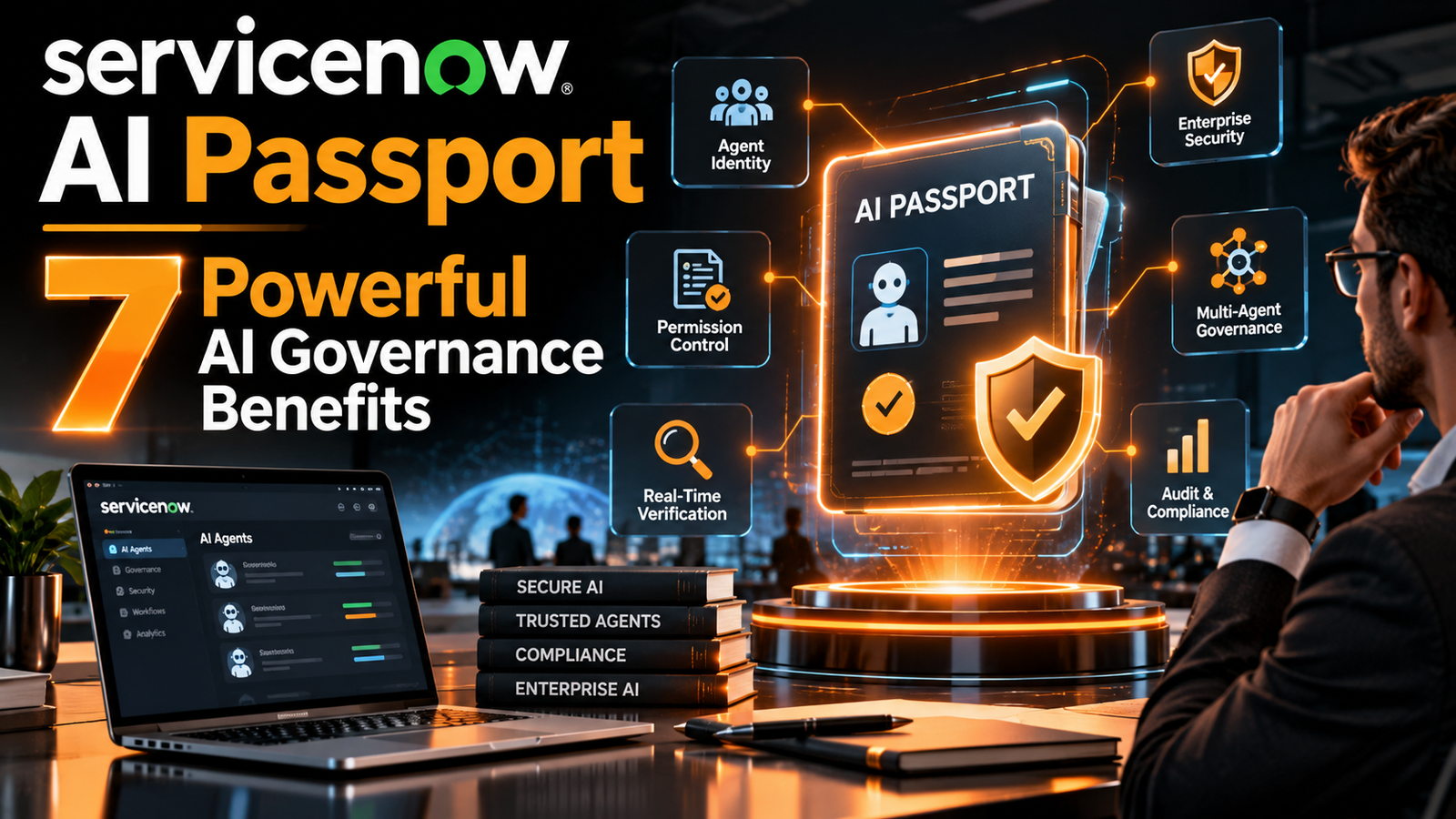
ServiceNow AI Passport is designed to address this challenge. Announced by ServiceNow on October 15, 2026, it is a governance capability intended to verify the permissions and authorized scope of AI agents while they are operating inside enterprise workflows. It is part of ServiceNow’s broader Super Intelligence Control Tower initiative.
This guide explains how the technology works, its potential features, business applications, benefits, limitations, and what organizations should consider before adopting it.
What Is ServiceNow AI Passport?
ServiceNow AI Passport is a proposed authority and permission layer for enterprise AI agents. In simple terms, it helps an organization define what an AI agent is allowed to do and check those permissions while the agent is performing a task.
Think of an AI agent as a digital assistant that can interact with company systems. It might help manage support tickets, retrieve customer information, or coordinate a workflow. However, giving an agent access to business systems without clear boundaries can create security and compliance risks.
ServiceNow AI Passport aims to provide each agent with a verifiable credential that represents its authorized scope. The credential can be checked during a workflow, including when multiple agents work together.
According to ServiceNow’s announcement, the solution uses cryptographically signed credentials and is designed to work with both ServiceNow-built and third-party AI agents. Its goal is to make permissions enforceable during execution rather than relying only on reviewing activity afterward.
Important: This is enterprise AI governance technology, not a travel passport, personal identity document, or consumer AI chatbot.
Why AI Agents Need Permission Controls
AI agents can do more than generate text. Depending on their configuration, they may access data, call tools, trigger workflows, or communicate with other software.
That creates several questions for enterprise teams:
-
Which AI agents are operating in the organization?
-
What data can each agent access?
-
Which actions can it perform?
-
Who approved those permissions?
-
What happens if an agent attempts an action outside its authorized scope?
Traditional security systems often focus on people, applications, and established service accounts. AI agents introduce a more dynamic challenge because they may make decisions and initiate actions across multiple systems.
ServiceNow AI Passport is intended to add an authorization layer specifically for these AI-driven activities. It complements broader security and governance processes rather than replacing them.
7 Important Features of ServiceNow AI Passport
The following seven points describe the announced capabilities and their practical significance. They are not a claim that the product has seven separate modules or a numbered feature list from ServiceNow.
1. Verifiable AI Agent Credentials
One of the central capabilities of ServiceNow AI Passport is issuing or verifying credentials that establish an AI agent’s authorized scope.
These credentials are intended to provide a more dependable way to confirm an agent’s permissions than simply accepting the agent’s own statements about what it is allowed to do.
For example, an AI agent assigned to IT support might have permission to retrieve a device’s status and create a service ticket. Its credential could help an enforcement system verify whether those actions fall within its approved scope.
The important distinction is that an AI agent’s identity and its permissions should be verifiable independently of the agent’s own reasoning.
2. Real-Time Permission Verification
A permission check that happens only after an action has been completed may be too late to prevent an unwanted change.
ServiceNow AI Passport is designed to verify authorized scopes at runtime. Runtime means while the AI agent is carrying out a task, rather than only during initial setup or a later audit.
This approach is intended to help organizations evaluate whether an agent is authorized to access a resource or perform an operation at a particular point in a workflow.
The benefit is preventive governance: the organization can make a permission decision before an action proceeds.
3. Support for Third-Party AI Agents
Enterprise organizations rarely use just one AI platform. They may have agents developed internally or supplied by different software vendors.
ServiceNow says AI Passport is built around open specifications so credentials can be issued and verified for first-party and third-party AI agents. That approach is intended to support governance across a mixed AI environment rather than limiting oversight to a single vendor’s agents.
This capability could be particularly relevant to organizations connecting AI agents with enterprise applications, workflow platforms, or external tools.
However, compatibility with a particular third-party agent should be confirmed with the vendor and implementation team. Open specifications do not automatically mean every integration works without configuration.
Read more: Fashionisk.com: Complete Website Review, Fashion Trends, Features & Safety Guide for 2026
4. Controlled Delegation Between Agents
Some enterprise workflows involve multiple AI agents. One agent might receive a request, another might gather information, and a third might perform an approved operation.
In these situations, permissions need to remain clear as work moves between agents.
ServiceNow AI Passport is designed to support scoped delegation, including permissions that can become narrower at different stages of a multi-agent workflow.
For example, an agent that passes a task to another agent should not automatically grant the second agent every permission held by the first. The receiving agent’s authorized scope needs to be considered separately.
This kind of permission boundary is important when AI systems coordinate tasks across departments or business applications.
5. Restriction and Revocation of Access
AI governance is not just about granting access. Organizations also need a way to change or withdraw permissions when circumstances change.
ServiceNow’s announcement describes precision revocation and graduated enforcement responses. Depending on the implementation, an agent that moves outside its authorized scope may be redirected, restricted, or disconnected from the workflow. The announcement also refers to kill-switch capabilities.
These controls are intended to give administrators a way to respond when an agent’s behavior no longer matches its approved permissions.
Actual enforcement depends on the systems involved and how the organization configures the controls. A governance credential alone does not guarantee that every external system will block every unauthorized action.
6. Audit Trails and Accountability
Enterprise AI decisions may need to be reviewed for security, compliance, troubleshooting, or operational accountability.
ServiceNow describes AI Passport as part of a broader governance environment that records the authorization context behind agent actions.
A useful audit process should help an organization answer:
-
Which agent attempted an action?
-
What permissions applied at that time?
-
Was the action authorized?
-
Which system approved or rejected it?
-
What happened next?
The value of an audit trail is not simply keeping a record. It is making the record useful enough for security and operations teams to investigate incidents and improve controls.
Organizations should still review their own retention policies, access restrictions, and audit requirements before deployment.
7. Integration With Enterprise AI Governance
AI Passport is being introduced alongside ServiceNow’s Super Intelligence Control Tower, which is intended to provide broader discovery, visibility, control, and measurement for enterprise AI.
ServiceNow says its governance capabilities connect authorization decisions with enterprise context, including configuration data, governance and risk policies, and workflow approvals. The announcement also identifies NVIDIA as a design and launch partner for an enforcement implementation using NVIDIA’s Open Agent Safety Platform.
This wider context matters because permissions are more meaningful when they reflect the organization’s actual systems, policies, and approved workflows.
How ServiceNow AI Passport Works
A simplified view of the process can help explain the technology without getting lost in security terminology.
Step 1: Identify the AI agent
An organization first needs to know which AI agent is requesting access to a system or resource.
The agent’s identity provides the starting point for checking its approved permissions. This is particularly important when an enterprise uses agents from different vendors or teams.
Step 2: Establish the authorized scope
The organization defines the tasks, data, and systems an agent is allowed to use.
For instance, a customer-support agent might be authorized to view a support case and prepare a response, but not to approve a financial refund without additional authorization.
The scope should reflect business policies, access controls, and the sensitivity of the information involved.
Step 3: Verify the credential during execution
When the agent attempts an operation, the relevant enforcement point checks whether its credential and requested action match the approved scope.
If the action is within scope, it may proceed according to the configured policy. If it is outside scope, the system can apply an appropriate restriction or other response.
Step 4: Record the outcome
The organization should be able to review the authorization decision and related activity.
That record can help security teams understand what happened, investigate unusual behavior, and assess whether the policy needs improvement.
This is a simplified explanation of the announced approach, not a complete technical implementation guide. Exact configuration steps and supported integrations should be verified against current product documentation.
Real-World Use Cases for ServiceNow AI Passport
The usefulness of AI governance becomes clearer when connected to business scenarios.
IT Service Management
An IT support agent may help classify incidents, gather troubleshooting information, or recommend a resolution.
With appropriate permission controls, the organization could distinguish between actions an agent may perform independently and actions that require a human technician’s approval.
For example, reading a device’s configuration may be permitted while changing a production system could require a separate authorization.
Human Resources Operations
An HR agent may assist with employee questions, onboarding workflows, or retrieving policy information.
Because HR systems contain sensitive employee information, organizations need to define which records an agent may access and what actions it may perform.
An AI governance layer can help enforce those boundaries, although employee privacy and HR policy controls remain necessary.
Customer Support
A customer-service agent may retrieve order details, summarize a complaint, or prepare a response.
The company could authorize access to specific customer records while restricting unrelated information or sensitive account changes.
This helps organizations think about permissions at the level of individual tasks rather than giving every AI agent broad access to the entire customer database.
Read more: Gugihjoklaz1451 Decoded: A Masterclass in Digital Artifacts and Search Logic
Security Operations
Security teams may use AI agents to investigate alerts, gather evidence, or recommend responses.
An agent might be allowed to collect information about a suspicious event while requiring approval before making a major change to a business-critical system.
ServiceNow AI Passport’s announced scope-verification approach is relevant to this kind of separation between investigation and execution.
Finance and Procurement
Finance and procurement workflows can involve invoices, vendor records, purchase requests, and approvals.
An AI agent might help check whether a document is complete or prepare a purchase request. However, organizations may want separate approval controls before money is committed or a vendor’s payment details are changed.
These examples are potential applications of enterprise AI governance. They should not be read as confirmation that every scenario is supported out of the box by AI Passport.
ServiceNow AI Passport: Benefits for Businesses
Better control over AI access
Clear permission boundaries can help reduce the risk of an AI agent accessing data or performing actions beyond its approved role.
The quality of that protection depends on how well the permissions are defined and enforced across connected systems.
More consistent governance
Organizations using multiple AI platforms may benefit from a common framework for verifying agent authority.
This could make governance easier to coordinate across IT, security, operations, and business teams, especially when agents work together.
Improved visibility and accountability
Authorization records and audit trails can help organizations understand how AI agents interact with their systems.
This may make it easier to investigate unusual actions, assess policy compliance, and explain decisions to internal stakeholders.
Support for responsible AI deployment
Companies often want to expand AI automation without granting unlimited access to enterprise resources.
ServiceNow AI Passport is aimed at supporting that balance: allowing useful automation while preserving defined boundaries and oversight.
These are intended benefits, not guaranteed outcomes. Security effectiveness depends on implementation quality, organizational policy, testing, and the controls surrounding each connected application.
Limitations and Important Considerations
No enterprise AI governance tool should be treated as a complete security solution on its own.
Permissions need careful design
If an organization grants an agent excessive permissions, a credential that accurately represents those permissions may still allow risky activity.
The authorization model needs to be reviewed against real business requirements.
External systems may require additional controls
An AI agent can interact with tools and applications outside a central platform.
The organization should verify that the relevant enforcement points can actually check and apply authorization decisions. A credential cannot independently protect a system that does not verify it.
Governance does not eliminate AI errors
Even an appropriately authorized agent may produce inaccurate information, misunderstand a request, or make a poor recommendation.
Human review remains important for sensitive or high-impact decisions. Organizations should also test agent behavior and establish a process for correcting mistakes.
Availability and implementation details matter
ServiceNow announced AI Passport on October 15, 2026, and said it was expected to become available in Q4 2026. That is a planned availability window, not confirmation that every customer can use it immediately.
Businesses should confirm current availability, licensing, supported environments, and integration requirements with ServiceNow before making purchasing or deployment decisions.
ServiceNow AI Passport vs. Traditional AI Governance
Traditional AI governance often combines policy documents, access management, monitoring, and audits. These controls remain important, but they may not provide a consistent way to verify an AI agent’s authority at every stage of an automated workflow.
The announced approach to ServiceNow AI Passport emphasizes authorization during execution.
| Governance approach | Main purpose |
|---|---|
| Traditional access management | Controls access for users, applications, and accounts |
| AI monitoring | Observes AI activity and identifies potential issues |
| Audit and compliance reviews | Examines activity and policy adherence |
| ServiceNow AI Passport | Verifies AI agent authority and scope during execution |
These approaches are complementary. AI Passport is not a replacement for identity management, cybersecurity, monitoring, or human approval processes.
Who Should Consider ServiceNow AI Passport?
The technology is primarily relevant to organizations that are moving beyond AI experiments and deploying agents into business-critical workflows.
It may be worth evaluating for:
-
Enterprise IT leaders responsible for AI deployment.
-
Security teams managing AI agent permissions.
-
Governance and compliance teams overseeing enterprise automation.
-
Organizations connecting AI agents to multiple business applications.
-
Businesses developing multi-agent workflows.
Smaller organizations using AI only for basic content generation may not need this type of specialized governance capability yet.
The decision should depend on the number of agents, the sensitivity of connected data, the actions agents can perform, and the organization’s existing security controls.
Frequently Asked Questions
1. What is ServiceNow AI Passport used for?
ServiceNow AI Passport is designed to verify and govern the permissions of enterprise AI agents while they execute tasks. It aims to help organizations control which resources and actions agents are authorized to use.
2. Is ServiceNow AI Passport an AI chatbot?
No. It is an AI governance and authorization capability. Its purpose is to help control AI agents, rather than serve as a general-purpose chatbot for conversations.
3. Does ServiceNow AI Passport support third-party agents?
ServiceNow has announced support for credentials involving both its own and third-party AI agents. Actual compatibility and integration requirements should be checked for each environment.
4. Is ServiceNow AI Passport available now?
ServiceNow announced the solution on October 15, 2026, with availability expected in Q4 2026. Organizations should check the latest official product information to confirm whether it is available for their specific deployment.
5. Does ServiceNow AI Passport guarantee AI security?
No. It is intended to strengthen authorization and governance, but it does not guarantee that an AI system will never make a mistake or that every connected application will enforce permissions correctly.
Conclusion: Is ServiceNow AI Passport Worth Watching?
Enterprise AI is moving from answering questions toward carrying out tasks across business systems. That shift makes authorization, accountability, and operational oversight increasingly important.
ServiceNow AI Passport represents an approach to verifying AI agent permissions during execution. Its announced features include verifiable credentials, runtime scope checks, controlled delegation, permission revocation, and auditability.
For organizations planning to deploy AI agents at scale, the concept is worth evaluating. The most important questions are whether it supports the organization’s actual agent environment, whether enforcement works across connected systems, and whether its controls align with existing security policies.
The technology’s real value will depend on how effectively those capabilities work in production—not simply on the announcement or the feature list.
