
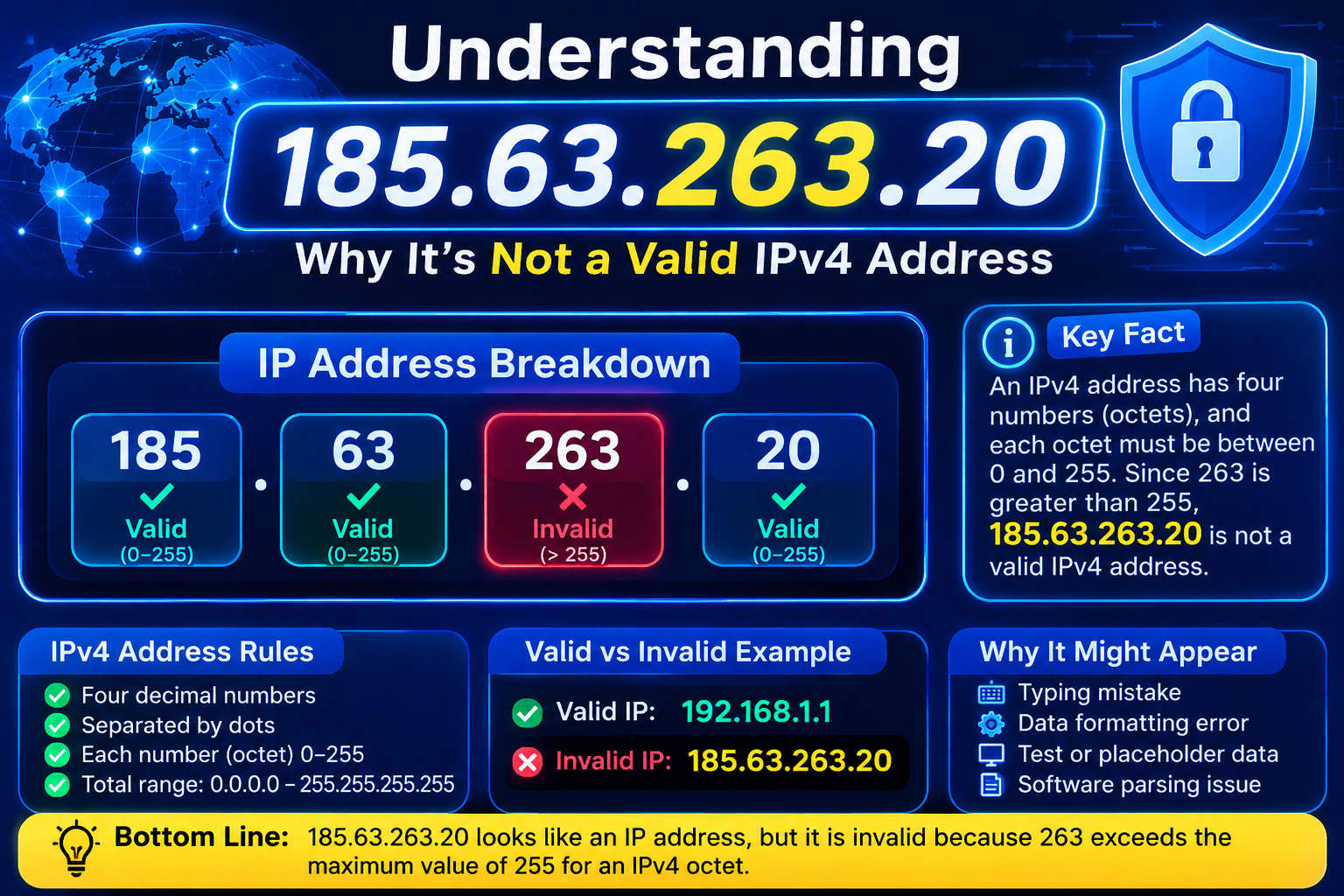
If you have recently seen 185.63.263.20 in a network log, security alert, configuration file, or online search, you may wonder whether it is a real IP address and what information it can reveal. At first glance, it looks like an ordinary IPv4 address because it contains four numerical sections separated by dots.
However, there is an important technical issue with this particular address. 185.63.263.20 is not a valid IPv4 address because one of its numerical sections is higher than the maximum value allowed under the IPv4 addressing system. The third section is 263, while an IPv4 octet can only range from 0 to 255.
This distinction is important for anyone researching IP addresses, troubleshooting networks, analyzing security logs, or learning how internet addressing works. In this guide, we will explain what 185.63.263.20 means, why it is invalid, why an address like this may appear in logs, and what you should do if you encounter it.
What Is 185.63.263.20?
185.63.263.20 appears to follow the basic visual format of an IPv4 address. IPv4 addresses contain four numerical sections known as octets. Each section is separated by a period.
For example, a standard IPv4 address might look like:
192.168.1.1
Each of the four numbers must fall between 0 and 255. This rule exists because each octet represents eight bits, and eight bits can represent values from 0 through 255.
When we examine 185.63.263.20, three sections are within the accepted range:
185— valid63— valid263— invalid20— valid
The problem is the third octet, 263. Since 263 is greater than 255, the complete address cannot be used as a normal IPv4 address.
Therefore, it is more accurate to describe 185.63.263.20 as a malformed or invalid IPv4 string rather than a genuine routable internet address.
Why Is 185.63.263.20 Invalid?
The IPv4 addressing system has a strict numerical structure. An IPv4 address contains 32 bits divided into four groups of eight bits.
An eight-bit value has a maximum of 255. This gives every IPv4 octet the following valid range:
0 to 255
The structure of 185.63.263.20 can therefore be examined as follows:
| Octet | Value | Status |
|---|---|---|
| First | 185 | Valid |
| Second | 63 | Valid |
| Third | 263 | Invalid |
| Fourth | 20 | Valid |
Because even one octet falls outside the permitted range, the entire address is invalid.
This is the most important fact to understand when researching 185.63.263.20. It should not be treated like a normal public IP address that can be reliably geolocated, assigned to an ISP, or routed across the public internet.
Read more: Improve DH58GOH9.7 Software
Can 185.63.263.20 Be a Real Public IP Address?
No. 185.63.263.20 cannot function as a standard public IPv4 address because of the 263 octet.
A legitimate public IPv4 address must satisfy the rules of IPv4 formatting. Even though the first, second, and fourth sections look normal, the invalid third section makes the complete address unusable.
This also means that claims suggesting you can directly determine the exact owner, city, ISP, or physical location of 185.63.263.20 should be treated carefully. Before performing an IP lookup, the address itself needs to be valid.
Why Might 185.63.263.20 Appear in Logs?
If the address is invalid, you may reasonably ask why 185.63.263.20 appears in a log, article, database, or security-related discussion.
There are several possible explanations.
1. Human Typographical Error
The simplest explanation is a typing mistake. Someone may have intended to enter a valid address but accidentally typed 263 instead of another number.
For example, a nearby-looking address such as 185.63.236.20 would have a valid third octet, although it should not automatically be assumed to be the intended address without checking the original source.
2. Data Processing Problems
IP addresses can pass through databases, spreadsheets, APIs, monitoring systems, and log-processing pipelines. Poor validation or data transformation can sometimes result in malformed values being stored or displayed.
If 185.63.263.20 appears repeatedly in your own infrastructure, checking the application or system that generated the record is a sensible first step.
3. Incorrect Documentation
Technical articles, screenshots, tutorials, or internal documentation can contain incorrect IP addresses. Once an inaccurate value is published online, other websites may reproduce it without independently validating the address.
4. Automated or Malformed Input
Automated scripts can also generate invalid values because of programming mistakes or incorrect input handling. This is particularly relevant for security and network monitoring systems where large quantities of data are processed automatically.
The appearance of an invalid address does not automatically prove that an attack occurred. The surrounding event and source system need to be investigated.
Is 185.63.263.20 Dangerous?
By itself, 185.63.263.20 is not a normal routable IPv4 destination because it fails basic IPv4 validation.
That does not mean that every event containing the string is harmless. If it appears in a security alert, firewall record, application log, or suspicious message, the event itself may still deserve investigation.
For example, security teams can ask:
- Which application generated the value?
- Was the address manually entered?
- Did an automated system create it?
- Does the same event contain a valid IP address?
- Are there other malformed addresses in the same logs?
- Was there unusual traffic around the event?
- Did the system experience a configuration or parsing error?
This approach is more useful than assuming that the invalid address itself represents a malicious server.
How to Check an IP Address Correctly
Before searching for ownership or geographical information, always validate the IP address.
For 185.63.263.20, the validation is straightforward. Look at each octet and confirm that every number is between 0 and 255.
The third octet is:
263
Because:
263 > 255
the address fails IPv4 validation.
For legitimate addresses, additional investigation can include WHOIS information, Autonomous System details, routing data, reverse DNS records, and security reputation databases. These techniques are commonly used when analyzing genuine IP addresses.
185.63.263.20 and IP Geolocation
Many people search for an IP address because they want to know its location. IP geolocation can sometimes provide an approximate country, region, city, network provider, or hosting organization for a valid address.
However, 185.63.263.20 should not be treated as a normal geolocation target because it is structurally invalid.
Even with valid IP addresses, geolocation is not equivalent to finding someone’s exact physical address. VPNs, proxies, mobile networks, corporate networks, hosting providers, and other technologies can affect the location information returned by IP databases.
Therefore, it is important not to confuse an IP lookup with precise physical tracking.
Read more: OkayMuz.org
185.63.263.20 vs. a Valid IPv4 Address
The easiest way to understand the issue is to compare the malformed address with a valid example.
A valid IPv4 address might look like:
203.0.113.10
Every octet in this example falls within the 0–255 range.
By contrast:
185.63.263.20
contains an octet that exceeds 255.
The visual format alone is not enough to make an IP address valid. All four numerical components must meet the IPv4 rules.
Could It Be an IPv6 Address?
No. 185.63.263.20 is written in dotted-decimal notation, which is associated with IPv4.
IPv6 uses a different addressing format based on hexadecimal groups separated by colons. A typical IPv6 address looks very different from an IPv4 address.
Therefore, the fact that 185.63.263.20 is not valid IPv4 does not mean it should be interpreted as IPv6. It simply fails the requirements for a standard IPv4 address.
What Should You Do If You See 185.63.263.20?
If you encounter 185.63.263.20, there is no need to panic. Instead, treat it as an invalid input and investigate where it came from.
Step 1: Validate the Address
Check all four octets. The third octet, 263, immediately identifies the formatting problem.
Step 2: Identify the Source
Determine whether the value came from:
- A server log
- Firewall software
- A browser
- An application
- A database
- A security alert
- A configuration file
- A manually entered record
Step 3: Look for a Typo
Review surrounding records to determine whether a valid IP was entered incorrectly.
Step 4: Check the Original Event
If the value appeared in a security alert, investigate the complete event rather than focusing only on the malformed IP.
Step 5: Improve Input Validation
If your own software is generating values such as 185.63.263.20, add proper IP validation before storing or processing network addresses.
This can help prevent malformed data from reaching security systems, dashboards, databases, and automated workflows.
Why IP Validation Matters for Cybersecurity
IP validation is a small but important part of cybersecurity and network management.
Security systems often process huge amounts of information. If malformed addresses are accepted without validation, they can create unnecessary alerts, inaccurate reports, and confusing investigation results.
A strong validation process helps separate legitimate network indicators from bad data.
For example, an organization could reject an IPv4 value whenever one of its octets is outside the 0–255 range. Invalid entries can then be stored separately for investigation instead of being treated as genuine network destinations.
This is especially useful for SIEM platforms, firewalls, intrusion detection systems, log pipelines, and network monitoring applications.
Common Mistakes When Researching 185.63.263.20
One common mistake is assuming that every dotted number found online is automatically a real IP address.
Another mistake is entering an invalid IP into several lookup services and treating the resulting information as authoritative.
A third mistake is assuming that an IP address can always identify a specific person. Even when an IP is valid, ownership information generally identifies a network provider, organization, hosting company, or allocation holder rather than proving the identity of an individual.
When researching 185.63.263.20, validation should always come before geolocation or ownership research.
Does 185.63.263.20 Have an ISP or Owner?
Because 185.63.263.20 is not a valid IPv4 address, you should not rely on ordinary IP ownership or geolocation claims associated with it.
A valid IP can be investigated using registration databases, routing information, reverse DNS, and other network intelligence sources. But those methods depend on having a properly formed IP address in the first place.
If you found this address in another article or document, it is better to return to the original source and determine whether the number was copied incorrectly.
Frequently Asked Questions About 185.63.263.20
What is 185.63.263.20?
185.63.263.20 is an incorrectly formatted IPv4 address. Its third octet is 263, which exceeds the maximum allowed value of 255.
Is 185.63.263.20 a valid IP address?
No. 185.63.263.20 is not a valid IPv4 address because every IPv4 octet must be between 0 and 255.
Why is 185.63.263.20 invalid?
The third section of the address is 263. Since 263 is greater than 255, the address fails standard IPv4 formatting rules.
Can I trace 185.63.263.20?
You should not treat it as a normal traceable public IP because the address itself is invalid. If it appeared in a log, investigate the source event and check whether a typing or data-processing error occurred.
Is 185.63.263.20 dangerous?
The string itself is not a normal routable IPv4 address. However, if it appears in a suspicious security event, the surrounding activity should still be reviewed.
Can an IP address reveal someone’s exact home address?
Generally, no. Even valid IP geolocation usually provides approximate network or geographic information rather than a guaranteed physical street address.
What should I do if this IP appears in my logs?
First validate the address, identify the system that generated it, inspect the surrounding log entries, and look for configuration or data-processing problems.
Final Thoughts on 185.63.263.20
185.63.263.20 may look like a conventional internet address, but a closer technical examination reveals that it is not a valid IPv4 address. The reason is simple: the third octet is 263, while IPv4 octets can only contain values from 0 through 255.
Understanding this detail is important before attempting an IP lookup, location search, ownership investigation, or security assessment. Instead of assuming that 185.63.263.20 belongs to a particular server or person, first determine why the malformed value appeared.
It could be the result of a typo, incorrect documentation, faulty data processing, or malformed automated input. In a cybersecurity environment, the surrounding event should be investigated rather than treating the invalid address as proof of malicious activity.
Ultimately, 185.63.263.20 provides a useful reminder that IP research should always begin with basic validation. Once an address is confirmed to be valid, tools such as WHOIS, reverse DNS, routing databases, and security intelligence services can provide more meaningful information. For an invalid address, however, identifying the source of the error is the more appropriate first step.
