
Introduction
Finding suitable CAD software can be challenging, especially for beginners and users who want useful design features without an overly complicated workflow. CAD programs are commonly used for technical drawings, layouts, product concepts, architectural plans, and basic three-dimensional designs.
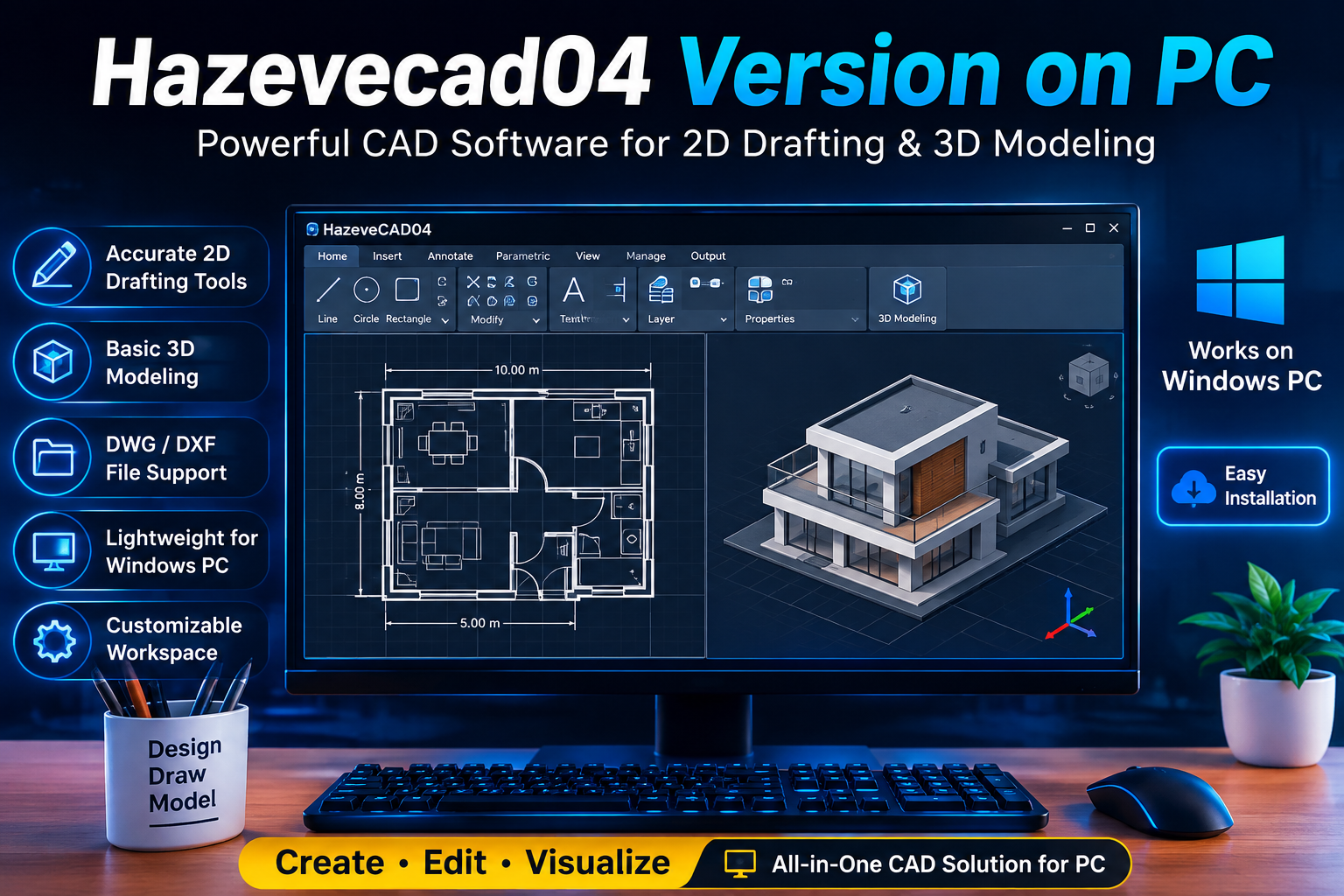
The hazevecad04 version on pc is presented as a desktop CAD solution for users interested in 2D drafting and basic 3D modeling. Its potential use cases include architecture, mechanical design, product development, education, and other computer-aided design tasks.
This guide looks at the main features, possible applications, system requirements, setup process, benefits, limitations, and beginner-friendly tips. It also explains what users should consider before adding this software to their regular design workflow.
What Is Hazevecad04 Version on PC ?
Hazevecad04 Version on PC is described as computer-aided design software focused on creating precise drawings and basic models. A desktop environment can be useful for CAD because a larger screen provides more room for drawing areas, toolbars, layers, and property panels.
The software may appeal to students, beginners, freelancers, and small-scale designers who mainly need essential drafting and modeling capabilities.
CAD software can be used for many different purposes. Depending on the available tools, users may create floor plans, technical drawings, product concepts, layouts, and simple 3D models.
However, the right software depends on the complexity of the project. Users working on advanced engineering simulations or highly detailed 3D assemblies should compare the available capabilities carefully before choosing a CAD application.
7 Key Features of Hazevecad04 Version on PC
1. Simple User Interface
A straightforward interface can make CAD easier to learn.
Beginners often need time to understand drawing commands, layers, dimensions, object properties, and file management. An organized workspace can help users focus on these fundamentals without becoming overwhelmed.
Experienced users can also benefit from a clean interface when working on smaller projects that do not require advanced tools.
2. Accurate 2D Drafting
2D drafting is an important part of many CAD workflows.
The software is described as supporting common drafting functions such as layers, dimensions, hatching, and drawing layouts. These tools can be useful for creating:
- Floor plans
- Technical drawings
- Basic engineering layouts
- Architectural drawings
- Product sketches
- Design concepts
Accurate 2D drawings can also serve as the foundation for later modeling or documentation.
3. Basic 3D Modeling
Another notable capability is basic 3D design.
Three-dimensional modeling allows users to turn simple drawings and concepts into visual models. This can be useful when developing product ideas, studying basic structures, or understanding how different components fit together.
The available information describes the software as supporting basic 3D functionality rather than competing directly with highly specialized professional modeling platforms.
For beginners, this can provide an opportunity to learn the basic principles of 3D CAD before moving to more advanced tools.
Read more: 185.63.263.20:
4. Customizable Workspace
Every designer has a different working style.
A customizable workspace can allow users to organize frequently used tools and adjust the interface around their preferred workflow. This can make navigation easier during longer design sessions.
Students may prefer a simple layout containing only essential tools, while experienced users may want quick access to additional commands.
5. Common CAD File Formats
File compatibility is an important consideration when selecting CAD software.
The available information associates Hazevecad04 Version on PC with commonly used CAD formats such as DWG, DXF, and DWT.
These formats can be important when exchanging drawings between different applications or sharing projects with other users.
Before using a particular format for an important project, it is still sensible to test the import and export process with the installed version.
6. Moderate Hardware Requirements
The software is presented as a relatively accessible option for computers with moderate hardware.
The listed requirements include a compatible Windows operating system, an Intel Core i3-class processor or better, at least 4 GB of RAM, and approximately 500 MB of storage. More RAM and stronger graphics hardware may be beneficial for larger or more demanding projects.
Actual performance can vary depending on the size of the drawing, number of objects, 3D complexity, and computer configuration.
7. Backup and File Protection Considerations
Design files can represent significant amounts of work, so protecting project data is important.
The supplied information mentions features related to authentication, encrypted storage, and cloud backup. Because software capabilities can change between versions, users should verify these functions in the specific version they install.
Regardless of built-in features, keeping an additional backup of important CAD projects is a smart practice.
Benefits of Using HazeveCAD04 on a PC
There are several reasons users may want to consider a desktop CAD application.
Beginner-Friendly Workflow
A simpler environment can help new users learn fundamental CAD concepts.
2D Design Support
Drafting tools can be useful for plans, layouts, technical drawings, and basic design documentation.
Basic 3D Options
Users can explore three-dimensional modeling without necessarily starting with an extremely complex professional application.
Flexible Workspace
Interface customization can make frequently used tools easier to access.
CAD File Compatibility
Support for common CAD formats can make project exchange more convenient.
Reasonable Hardware Needs
The listed requirements suggest that users may not need a high-end workstation for basic projects.
Hazevecad04 Version on PC for Architecture
Architectural design frequently involves both two-dimensional drawings and three-dimensional visualization.
A user may begin with a simple floor plan, add measurements and details, and then create a basic representation of the structure.
For students and small projects, this type of workflow can be useful for understanding architectural drawing principles.
However, professional architectural work can involve specialized documentation, rendering, collaboration, and building-information features. Users should therefore compare their requirements with the software’s actual capabilities.
Hazevecad04 Version on PC for Mechanical Design
Mechanical design relies heavily on accurate dimensions and representations of components.
A CAD application can help users create technical drawings and visualize basic parts before moving toward physical prototyping.
The hazevecad04 version on pc may be suitable for learning fundamental mechanical CAD concepts and handling smaller design tasks.
For complex assemblies, advanced simulations, manufacturing workflows, or highly specialized engineering projects, users may need more advanced software.
Hazevecad04 Version on PC for Product Design
Product designers often begin with rough ideas before developing detailed digital concepts.
A CAD workflow can help turn those ideas into measurable drawings and basic 3D representations. Designers can then examine dimensions, proportions, and overall shape before creating a physical prototype.
For simple product concepts and educational projects, basic CAD functionality can be a useful starting point.
System Requirements
Before installing any design application, users should check whether their computer meets the expected requirements.
| Requirement | Listed Specification |
|---|---|
| Operating System | Windows 7, 8, 10, 11 |
| Architecture | 64-bit recommended |
| Processor | Intel Core i3 or higher |
| RAM | 4 GB minimum |
| Recommended RAM | 8 GB |
| Storage | Around 500 MB |
| Graphics | Integrated graphics |
| 3D Work | Dedicated GPU recommended |
These specifications should be treated as reference information rather than a guarantee of performance. A more powerful computer can provide a smoother experience when working with larger drawings or more demanding 3D projects.
How to Set Up HazeveCAD04 on PC
If you decide to try the software, follow a careful setup process.
Step 1: Verify the Source
Download software only from a legitimate and trustworthy source. Avoid unknown modified installers or suspicious files.
Step 2: Check Your Computer
Compare your operating system, processor, RAM, storage, and graphics hardware with the available requirements.
Step 3: Install the Software
Use the legitimate installer and follow the instructions provided during installation.
Step 4: Configure the Workspace
After installation, arrange the interface and tools according to your preferred workflow.
Step 5: Test a Small Drawing
Create a simple project before working on an important design. Test basic functions such as opening, saving, importing, exporting, and viewing your drawing.
This can help identify compatibility problems early.
Read more: BrassSmile.com
Is Hazevecad04 Version on PC Good for Beginners?
For people who are new to CAD, learning the fundamentals is often more important than having dozens of advanced features.
A beginner can start by learning:
- Basic drawing commands
- Layers
- Dimensions
- Object selection
- File management
- Simple layouts
- Basic 3D concepts
Once these skills become familiar, users can decide whether they need a more advanced CAD platform.
The hazevecad04 version on pc may therefore be worth exploring for learners who want to practice fundamental CAD workflows.
Limitations to Keep in Mind
Before choosing any CAD application, it is important to consider its limitations.
Advanced 3D Work
Users who create complicated assemblies or highly detailed models may need more specialized tools.
Plugin Ecosystem
Larger CAD platforms often have extensive libraries of third-party extensions. A smaller ecosystem may provide fewer options for specialized workflows.
Collaboration
Users working in large teams should check how project sharing, version management, and collaboration work before depending on the software for a major project.
Professional Requirements
A tool that works well for learning or small projects may not necessarily meet the requirements of a large engineering or architectural company.
Hazevecad04 Version on PC vs. Advanced CAD Platforms
The biggest difference between a lightweight CAD solution and a high-end platform is usually the depth of available functionality.
Advanced CAD applications may offer sophisticated modeling, simulation, rendering, automation, collaboration, and extensive plugin ecosystems.
Hazevecad04 Version on PC is instead presented as a more accessible option for essential 2D drafting and basic 3D work.
It may be worth considering for:
- Students
- Beginners
- Freelancers
- Small design projects
- Basic drafting
- Introductory 3D modeling
Professionals should compare the software against their exact technical and business requirements before changing their existing workflow.
Tips for a Better CAD Workflow
Keep Your Files Organized
Create separate folders for different projects and use meaningful filenames.
Save Your Work Frequently
Regular saving can help protect your progress.
Create Backups
Keep important design files in a secondary secure location.
Close Unnecessary Applications
Freeing system resources can help when working on larger projects.
Update Graphics Drivers
Keeping compatible graphics drivers updated may help avoid performance or compatibility issues.
Test Before Starting a Major Project
A small test file can help you understand how the software behaves on your computer.
IsHazevecad04 Version on PC Worth Trying?
The answer depends on what you want to accomplish.
If your main goal is basic 2D drafting and introductory 3D modeling, the available feature set may be worth exploring. Its reported support for common CAD formats and moderate hardware requirements may also make it interesting for students and small-scale users.
However, users who need advanced simulations, complicated 3D assemblies, extensive plugins, or sophisticated team collaboration should investigate alternative CAD platforms as well.
The best software is not necessarily the one with the most features. It is the one that matches your actual project requirements, computer hardware, experience level, and workflow.
Frequently Asked Questions
What is hazevecad04 version on pc?
It refers to using Hazevecad04 Version on PC as a desktop CAD application on a PC. The available information describes it as a tool for 2D drafting and basic 3D modeling.
Is Hazevecad04 Version on PC suitable for beginners?
It may be suitable for beginners who want to learn basic CAD concepts and work with straightforward drawings and models.
What operating systems are listed?
The available specifications list Windows 7, 8, 10, and 11, with 64-bit recommended.
How much RAM is recommended?
The listed information gives 4 GB as a minimum and 8 GB as the recommended amount.
Can Hazevecad04 Version on PC handle 3D modeling?
Yes, the available information describes basic 3D modeling capabilities. More demanding 3D projects may require stronger hardware or a more advanced CAD platform.
Does it support common CAD formats?
The available information lists DWG, DXF, and DWT among the supported formats.
Is it suitable for professional projects?
It may work for basic professional drafting and smaller projects, but users with advanced engineering, modeling, simulation, or collaboration requirements should evaluate other options as well.
Final Verdict
The hazevecad04 version on pc can be an interesting option for users looking for a straightforward desktop CAD workflow. Its described strengths include 2D drafting, basic 3D modeling, workspace customization, common CAD file compatibility, and moderate hardware requirements.
It may be particularly useful for students, beginners, freelancers, and people working on smaller design projects.
At the same time, it is important to understand that basic CAD functionality may not be enough for every professional workflow. Complex 3D assemblies, advanced simulations, extensive plugins, and large-scale collaboration can require specialized software.
Before installing the application, verify the current developer information, official download source, licensing terms, system requirements, and security of the installer. This simple check can help you avoid unnecessary compatibility and security problems.
If the software’s capabilities match your needs, testing it with a small project is a practical way to decide whether it belongs in your CAD workflow.
