
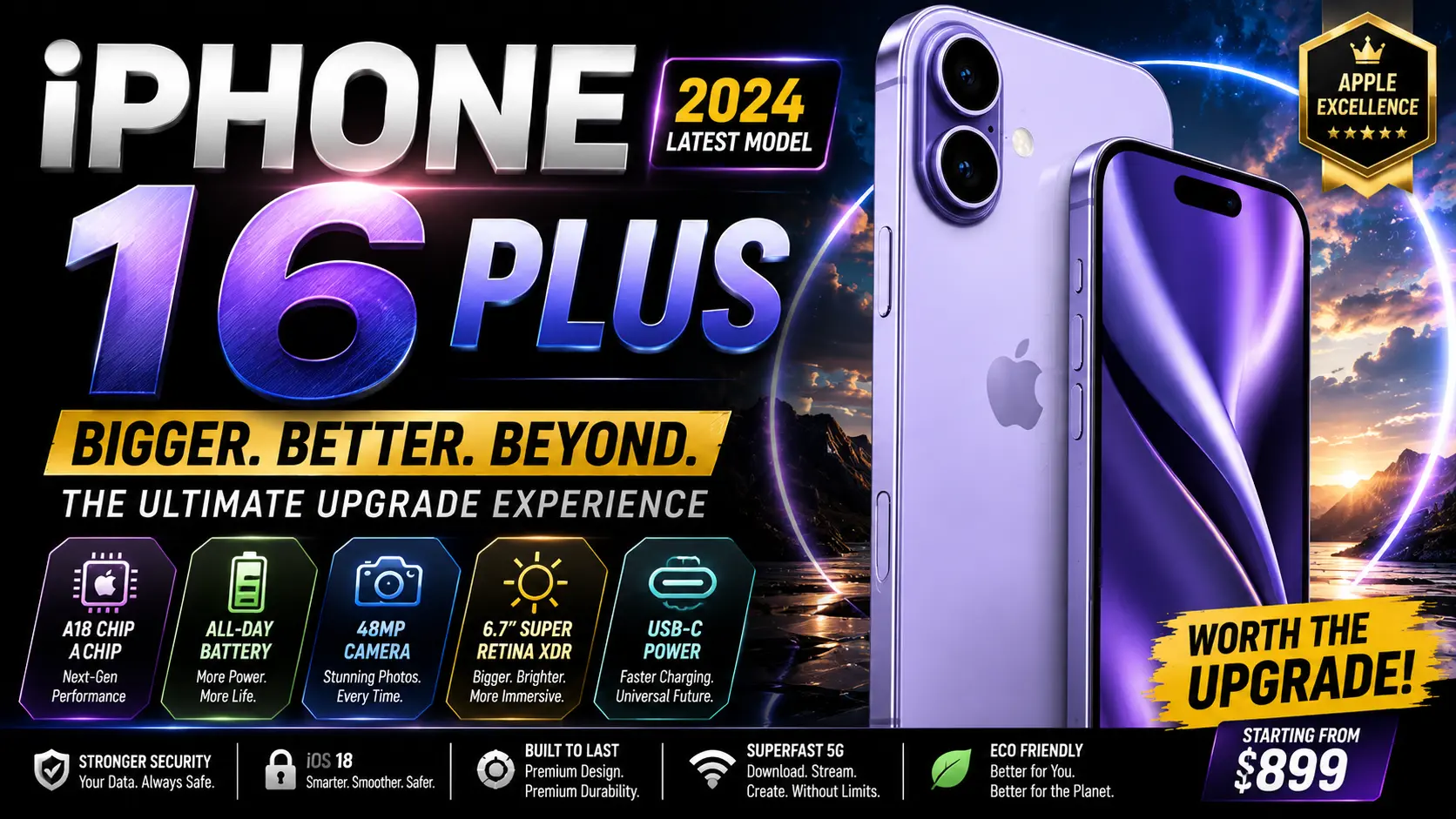
The iPhone 15 Plus has carved a solid space in the smartphone market since its launch. Apple designed this device for users who crave a large display without stepping into the premium Pro territory. It sits comfortably between the standard iPhone 15 and the Pro Max, offering a generous screen size paired with dependable performance. If you have been eyeing a phone that delivers excellent battery life, a vibrant display, and the latest Apple ecosystem features, this device deserves your attention.
Design and Build Quality
The iPhone 15 Plus showcases a refined design language that Apple has been perfecting over the years. It features an aluminum frame paired with a color-infused glass back that gives the device a frosted, matte-like finish. This subtle texture not only looks elegant but also resists fingerprints better than the glossy finishes found on previous models. The phone feels premium in hand, though its larger dimensions mean it is not the most pocket-friendly device available.
Apple introduced contoured edges on the iPhone 15 Plus, replacing the sharp, flat edges from the iPhone 14 series. This seemingly minor change makes a noticeable difference in comfort during extended use. Holding the phone for long periods feels natural, and the rounded edges reduce the digging sensation that some users complained about with earlier models.
The device is rated IP68 for dust and water resistance, meaning it can survive submersion in up to six meters of water for thirty minutes. This rating gives users peace of mind during accidental spills or unexpected rain. The Ceramic Shield front cover continues to provide industry-leading drop protection, and Apple claims it is tougher than any smartphone glass available.
Color options include black, blue, green, yellow, and pink. Each shade has a soft, pastel-like quality that feels modern and understated. The overall build quality lives up to Apple’s reputation, and the phone feels like a device built to last. At 201 grams, it is lighter than many competing large-screen phones, which contributes to a more comfortable daily experience.
One of the most talked-about design changes is the switch from Lightning to USB-C. This move aligns the iPhone with universal charging standards, making it easier to share cables with other devices like iPads, MacBooks, and even Android phones.
Display Performance
The iPhone 15 Plus features a 6.7-inch Super Retina XDR OLED display that delivers stunning visuals in every lighting condition. With a resolution of 2796 by 1290 pixels and a pixel density of 460 pixels per inch, text appears razor-sharp, and images look incredibly detailed. Whether you are scrolling through social media, watching movies, or editing photos, the screen quality is hard to fault.
Peak brightness reaches 2000 nits in outdoor conditions, making the display perfectly readable even under direct sunlight. This is a significant improvement over the iPhone 14 Plus, which topped out at 1200 nits. Indoor brightness is equally impressive, and the display adjusts intelligently based on ambient light to reduce eye strain during nighttime use.
The Dynamic Island replaces the old notch design and adds both aesthetic and functional value. It houses the front camera and Face ID sensors while also serving as an interactive element. Notifications, live activities, and background tasks appear as animated bubbles around the island, keeping important information accessible without interrupting your current activity.
One limitation worth noting is the 60Hz refresh rate. While the display looks beautiful in terms of color accuracy and brightness, scrolling and animations do not feel as fluid as they would on a 120Hz ProMotion display. Users coming from Android phones with high refresh rate screens may notice the difference. However, for the average user who is not particularly sensitive to refresh rates, the display remains excellent for daily tasks.
Color accuracy on this display is exceptional. Apple calibrates each panel to support the P3 wide color gamut, and HDR content from streaming platforms like Apple TV Plus and Netflix looks particularly impressive. The viewing angles are wide, and color consistency remains strong even when looking at the screen from sharp angles.
Camera System and Photography
The iPhone 15 Plus carries a dual-camera system on the rear, featuring a 48-megapixel main sensor and a 12-megapixel ultrawide lens. The main camera represents a massive upgrade from the 12-megapixel sensor used in the iPhone 14 Plus. With four times the resolution, photos contain significantly more detail, and cropping into images reveals information that would have been lost on the previous model.
Apple uses a quad-pixel sensor design on the main camera, which combines four pixels into one to produce highly detailed 24-megapixel images by default. Users also have the option to shoot in full 48-megapixel resolution when maximum detail is desired. This flexibility makes the camera system versatile enough for casual snapshots and more serious photography alike.
The ultrawide camera captures a 120-degree field of view, making it perfect for landscape photography, group shots, and architectural images. While it does not match the main sensor in terms of raw detail, it performs admirably in good lighting conditions and adds creative versatility to the camera system.
A notable addition to the iPhone 15 Plus camera experience is the 2x telephoto option. By cropping into the center of the 48-megapixel sensor, Apple effectively creates a 12-megapixel telephoto image with a 2x optical-quality zoom. This gives users three focal lengths to work with, covering wide, ultrawide, and medium telephoto perspectives.
Portrait mode has also received significant improvements. The phone now automatically captures depth information when it detects a person, cat, or dog in the frame. Users can apply the portrait effect after taking the photo, and they can even adjust the focus point in post-processing. This feature alone is worth the upgrade for anyone who enjoys portrait photography.
| Camera Feature | Specification |
|---|---|
| Main Camera | 48 MP, f/1.6, sensor-shift OIS |
| Ultrawide Camera | 12 MP, f/2.4, 120-degree field of view |
| Front Camera | 12 MP, f/1.9, autofocus |
| Video Recording | 4K at 24/25/30/60 fps, Cinematic mode |
Battery Life and Charging
Battery life is arguably the strongest selling point of the iPhone 15 Plus. Apple does not officially disclose battery capacity in milliamp hours, but estimates place it around 4383 mAh. What matters more than the number is real-world performance, and the iPhone 15 Plus delivers outstanding endurance that easily carries most users through a full day and often into the next morning.
In typical usage scenarios involving a mix of social media browsing, messaging, email, photo taking, and media consumption, the iPhone 15 Plus consistently lasts between ten and twelve hours of screen-on time. Heavy users who stream video content for extended periods or play graphically demanding games will still find the battery lasting a full day without issue.
Apple rates the iPhone 15 Plus for up to 26 hours of video playback, making it one of the longest-lasting iPhones ever released. For audio playback, the rating extends to an impressive 100 hours. These numbers highlight just how efficient the A16 Bionic chip is when paired with the large battery and power-optimized OLED display.
Charging speeds, however, remain a point of criticism. The phone supports wired charging at up to 20 watts via USB-C, which takes approximately 90 minutes for a full charge. A 30-minute charge brings the battery from zero to roughly 50 percent. While this is adequate, it lags behind competitors that offer 65-watt or even 120-watt fast charging.
Wireless charging is supported at up to 15 watts through MagSafe and 7.5 watts through standard Qi chargers. MagSafe continues to be a convenient option for users who prefer a cable-free charging experience, and the magnetic alignment ensures proper positioning every time.
| Charging Method | Speed | Time to Full |
|---|---|---|
| USB-C Wired | 20W | Approximately 90 minutes |
| MagSafe Wireless | 15W | Approximately 2.5 hours |
| Qi Wireless | 7.5W | Approximately 4 hours |
| Reverse Wired Charging | Not Supported | N/A |
Performance and A16 Bionic Chip
The iPhone 15 Plus is powered by the A16 Bionic chip, which originally debuted in the iPhone 14 Pro series. This means the Plus model benefits from a proven processor that has already demonstrated its capabilities in demanding tasks. The chip features a 6-core CPU with two performance cores and four efficiency cores, a 5-core GPU, and a 16-core Neural Engine.
In everyday use, the A16 Bionic handles everything without breaking a sweat. Apps open instantly, multitasking between several applications feels seamless, and there is no noticeable lag or stutter during normal operations. The chip is built on a 4-nanometer process, which contributes to excellent thermal management and power efficiency.
Gaming performance is particularly impressive. Titles like Genshin Impact, Call of Duty Mobile, and Asphalt 9 run smoothly at high graphic settings. The large display adds to the gaming experience by providing more screen real estate, and the stereo speakers deliver immersive audio that complements the visuals. While the phone does get warm during extended gaming sessions, it never becomes uncomfortably hot.
The Neural Engine handles machine learning tasks efficiently, powering features like text recognition, photo processing, Siri intelligence, and on-device dictation. These computational photography improvements are particularly noticeable in low-light photos and portrait mode processing, where the chip analyzes and enhances images in real time.
The iPhone 15 Plus is available in 128GB, 256GB, and 512GB storage configurations. There is no expandable storage option, so choosing the right capacity at the time of purchase is important. The 128GB base model is sufficient for most users, but those who shoot a lot of 48-megapixel photos and 4K videos should consider the 256GB or 512GB options.
RAM is listed at 6GB, which Apple manages so efficiently through iOS optimization that it rarely feels limiting. Apps stay in memory longer than expected, and switching between recently used applications rarely triggers a reload. The overall performance package is more than capable for the vast majority of users.
Software Experience and iOS Features
The iPhone 15 Plus ships with iOS 17, which brings a collection of new features and refinements that enhance the overall user experience. StandBy mode transforms the phone into a smart display when placed on its side while charging, showing clocks, widgets, photos, or live activities. This feature is particularly useful on a bedside table or desk, turning the large display into a functional ambient screen.
Contact Posters allow users to customize how they appear when calling someone. You can choose a photo, Memoji, or monogram along with font and color preferences. When you call another iPhone user running iOS 17, your personalized poster appears on their screen, adding a touch of personality to phone calls.
.
The Messages app received several welcome upgrades. A new catch-up arrow lets you jump to the first unread message in a conversation. Search filters help locate specific messages more quickly, and the stickers experience has been expanded with the ability to create live stickers from your photos. Check In is a safety feature that automatically notifies a chosen contact when you arrive at your destination.
Journal is a new app introduced with iOS 17 that encourages daily reflection by suggesting personalized prompts based on your recent activity, photos, workouts, and music. The app keeps entries private and secured with on-device processing, making it a thoughtful addition for users who enjoy journaling.
Safari improvements include better private browsing with Face ID lock, automatic tracking prevention, and profile support that separates work and personal browsing. The autocorrect system has been completely rebuilt using a transformer language model, resulting in significantly more accurate text predictions and corrections.
Apple has committed to providing software updates for the iPhone 15 Plus for at least five to six years, which means the device will continue receiving new features and security patches well into the future. This long software support cycle is a major advantage over most Android phones and adds considerable value to the purchase over time.
Connectivity and USB-C Transition
The switch from Lightning to USB-C is one of the most significant changes Apple made with the iPhone 15 series. This move brings the iPhone in line with iPads, MacBooks, and countless other devices that already use the universal standard. Users can now charge their iPhone, iPad, and Mac with the same cable, reducing clutter and simplifying travel packing.
The USB-C port on the iPhone 15 Plus supports USB 2.0 transfer speeds, which max out at 480 megabits per second. This is the same speed that Lightning offered, and it falls short compared to the USB 3 speeds available on the Pro models. For most users who primarily rely on cloud services and wireless transfers, this limitation will not be a dealbreaker. However, those who frequently transfer large files to a computer may find the speeds frustrating.
An interesting capability of the USB-C port is reverse charging. The iPhone 15 Plus can charge other devices like AirPods or an Apple Watch directly from its battery using a USB-C cable. While this feature drains the phone’s battery, it can be a lifesaver in situations where your accessories run out of power and no other charger is available.
The phone supports 5G connectivity across both sub-6GHz and mmWave bands, ensuring fast mobile data speeds in areas with 5G coverage. Wi-Fi 6 is included for reliable home and office wireless performance, and Bluetooth 5.3 provides stable connections with accessories like AirPods, Apple Watch, and third-party peripherals.
The Precision Finding feature for Find My works thanks to the second-generation Ultra Wideband chip. This chip also enables improved AirDrop functionality, where a file transfer continues over the internet even after two devices move out of AirDrop range. Emergency SOS via satellite remains available for users in areas without cellular coverage, providing a critical safety net during emergencies.
Comparison With Competitors
Choosing between the iPhone 15 Plus and its closest competitors requires understanding what each device prioritizes. The following table compares the iPhone 15 Plus against three popular alternatives across key specifications.
| Feature | iPhone 15 Plus | Samsung Galaxy S24 Plus | Google Pixel 8 Pro | iPhone 15 Pro Max |
|---|---|---|---|---|
| Display Size | 6.7 inches | 6.7 inches | 6.7 inches | 6.7 inches |
| Refresh Rate | 60Hz | 120Hz | 120Hz | 120Hz ProMotion |
| Processor | A16 Bionic | Snapdragon 8 Gen 3 | Tensor G3 | A17 Pro |
| Main Camera | 48 MP | 50 MP | 50 MP | 48 MP |
| Battery Life (Video) | 26 hours | 23 hours | 24 hours | 29 hours |
| Starting Price | $899 | $999 | $999 | $1199 |
| USB Port Speed | USB 2.0 | USB 3.2 | USB 3.2 | USB 3.0 |
| Weight | 201 g | 196 g | 213 g | 221 g |
The iPhone 15 Plus stands out for its superior battery life and lower starting price compared to the Galaxy S24 Plus and Pixel 8 Pro. However, it falls behind all three competitors in terms of display refresh rate. The 60Hz limitation is the most common criticism leveled at the device, and it becomes more noticeable when placed side by side with 120Hz screens.
Against the iPhone 15 Pro Max, the Plus model sacrifices the telephoto camera, ProMotion display, titanium build, Action Button, and faster USB speeds. However, it saves $300 in the process, making it an appealing option for users who do not need those premium features.
The Samsung Galaxy S24 Plus offers a more feature-rich package with its 120Hz display, faster charging, and S Pen support. The Google Pixel 8 Pro leads in computational photography and offers exclusive AI features powered by the Tensor G3 chip. Ultimately, the best choice depends on your priorities and ecosystem preference.
Pros and Cons
Every smartphone has strengths and weaknesses. The following table provides a balanced overview of what the iPhone 15 Plus does well and where it falls short.
| Pros | Cons |
|---|---|
| Exceptional battery life lasting a full day and beyond | 60Hz refresh rate feels outdated at this price point |
| Gorgeous 6.7-inch OLED display with 2000 nits brightness | No telephoto camera lens |
| Upgraded 48 MP main camera with 2x telephoto crop | USB 2.0 transfer speeds are slow |
| USB-C port for universal compatibility | 20W wired charging is slower than competitors |
| Lightweight at 201 grams for a large phone | Starting price of $899 may feel high for non-Pro features |
| Long software support with iOS updates for years | No always-on display feature |
| Dynamic Island adds useful interactive functionality | Base storage is only 128GB |
| IP68 water and dust resistance | No Action Button like Pro models |
| Improved portrait mode with after-capture editing | Limited customization compared to Android |
| Ceramic Shield for superior drop protection | MagSafe accessories add to overall cost |
Who Should Buy the iPhone 15 Plus
The iPhone 15 Plus is designed for a specific type of buyer. Understanding whether you fall into that category will help you decide if this is the right phone for you.
If battery life is your top priority, the iPhone 15 Plus is one of the best options available in the entire smartphone market. Its combination of a large battery and power-efficient chip delivers endurance that very few phones can match. Users who are tired of carrying a charger everywhere or constantly monitoring their battery percentage will appreciate the freedom this phone provides.
Content consumers who spend significant time watching videos, browsing the web, reading articles, and scrolling through social media will love the large 6.7-inch display. The screen quality is outstanding, and the stereo speakers produce rich, detailed audio that enhances the media experience. If your phone is your primary entertainment device, the Plus model delivers on every front.
Users who want a big-screen iPhone without paying the premium Pro Max price will find the iPhone 15 Plus to be excellent value. It offers the same screen size as the Pro Max at $300 less, and for everyday tasks, the experience is remarkably similar. The camera differences matter primarily to photography enthusiasts, and the 60Hz display is a non-issue for users who are not sensitive to refresh rate variations.
However, if you are a mobile photographer who relies heavily on optical zoom, a power user who demands the fastest possible performance, or someone who values a high refresh rate display, the Pro or Pro Max models would better serve your needs. The iPhone 15 Plus is a mainstream flagship, and it excels in that role without trying to be something it is not.
Frequently Asked Questions
Is the iPhone 15 Plus worth buying over the standard iPhone 15?
The iPhone 15 Plus offers two primary advantages over the standard model: a larger 6.7-inch display compared to the 6.1-inch screen and significantly better battery life. If screen size and endurance matter to you, the $100 premium is justified. Both phones share the same processor, camera system, and software features, so the decision comes down to personal preference regarding size and battery needs.
Does the iPhone 15 Plus have a 120Hz display?
No, the iPhone 15 Plus features a 60Hz refresh rate display. The 120Hz ProMotion technology is exclusive to the iPhone 15 Pro and iPhone 15 Pro Max. While the display on the Plus model excels in brightness, color accuracy, and sharpness, the lower refresh rate is noticeable during scrolling and animations compared to 120Hz screens.
Can the iPhone 15 Plus charge other devices?
Yes, the iPhone 15 Plus can charge other devices through its USB-C port. You can connect AirPods with a USB-C case or even an Apple Watch using a USB-C charging cable directly to the phone. This reverse charging feature is handy during travel when you need to top up an accessory without a separate charger.
How long will Apple support the iPhone 15 Plus with software updates?
Based on Apple’s track record with previous iPhone models, the iPhone 15 Plus is expected to receive iOS updates for at least five to six years. This means the phone should remain current with new features and security patches through 2029 or 2030, making it a solid long-term investment.
What is the best storage option for the iPhone 15 Plus?
The 128GB base model works well for users who rely on cloud storage and do not shoot excessive amounts of 4K video. However, since the 48-megapixel camera produces larger file sizes and there is no expandable storage, users who take many photos and videos should consider the 256GB option for comfortable headroom.
Does the iPhone 15 Plus support MagSafe?
Yes, the iPhone 15 Plus fully supports MagSafe accessories including chargers, cases, wallets, and car mounts. MagSafe charging delivers up to 15 watts of wireless power with precise magnetic alignment, making it a convenient alternative to plugging in a cable.
Final Verdict
The iPhone 15 Plus is a compelling smartphone that delivers where it matters most for the majority of users. Its exceptional battery life sets it apart from nearly every competitor, and the large OLED display provides an immersive canvas for everything from streaming content to casual gaming. The upgraded 48-megapixel camera system captures impressive photos in various conditions, and the switch to USB-C is a welcome modernization that simplifies the charging experience.
While the 60Hz refresh rate and slower USB 2.0 data transfer speeds are legitimate criticisms, they do not undermine the overall value proposition of the device. Apple has crafted a phone that prioritizes the features most users care about, including reliability, longevity, camera quality, and all-day battery endurance, while keeping the price more accessible than the Pro lineup.
For anyone seeking a large-screen iPhone that balances performance, features, and cost, the iPhone 15 Plus stands as one of the best choices available. It may not have every cutting-edge spec, but it nails the fundamentals with a level of polish and consistency that few competitors can match. If you value a phone that simply works brilliantly day after day without demanding constant attention or compromise, the iPhone 15 Plus deserves a spot at the top of your shortlist.
