
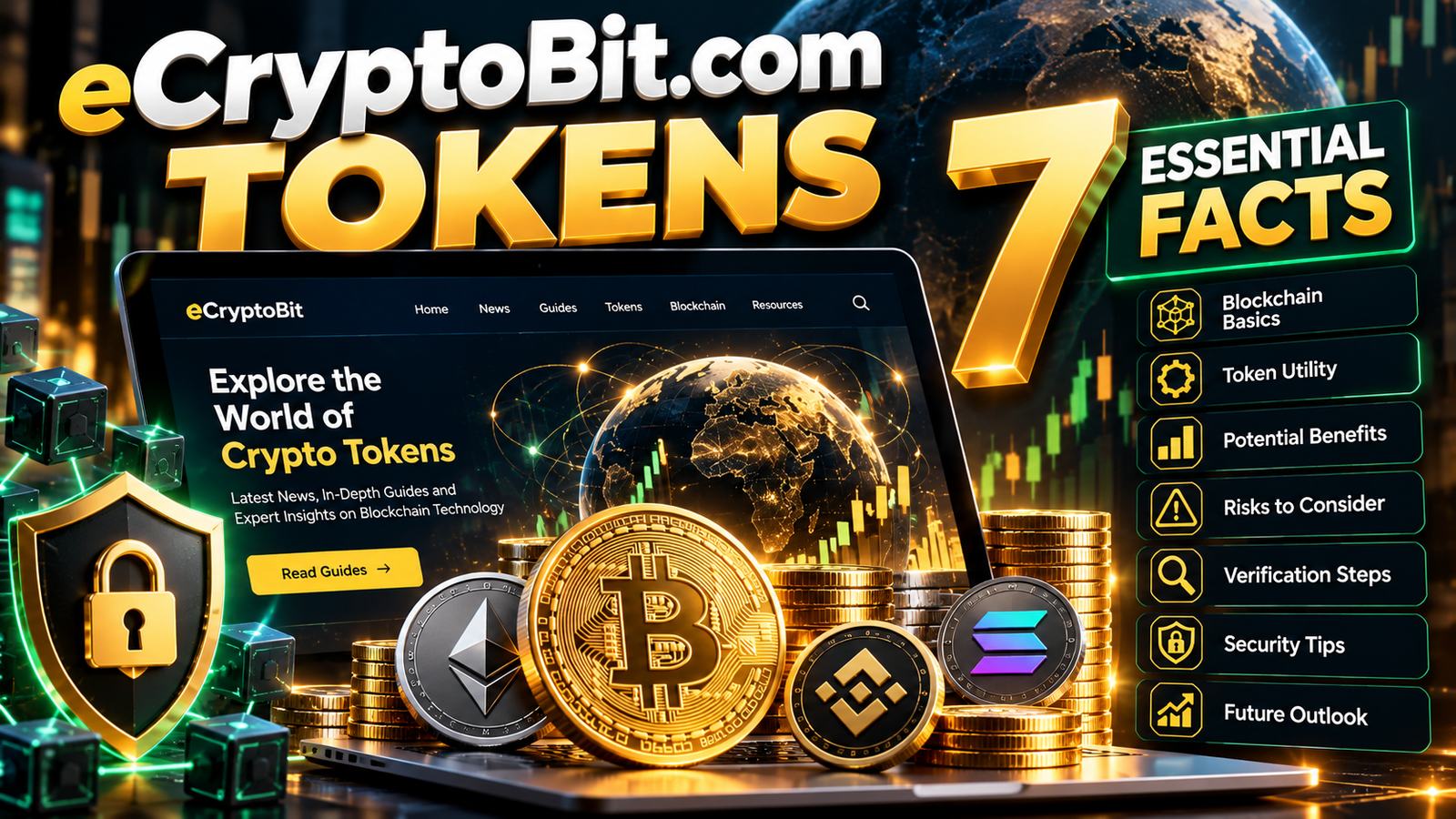
Cryptocurrency has opened new possibilities for digital payments, blockchain applications, and online financial systems. However, the rapid growth of the industry has also created confusion about new tokens, their purposes, and the websites that discuss them. Before trusting an unfamiliar crypto-related claim, readers need to understand the difference between verified information and speculation.
The search term eCryptobit.com tokens is an example of a topic that requires careful research. People searching for it may want to learn about digital assets, understand the ecryptobit website, or determine whether a specific cryptocurrency is officially associated with the brand.
The official ecryptobit website publishes educational material about cryptocurrency, blockchain technology, and token-related subjects. However, educational articles about tokens do not automatically prove that a website has launched its own cryptocurrency. A specific asset should be verified through official announcements and technical documentation.
This guide takes a research-based approach to eCryptobit.com tokens, explaining the technology behind digital assets, how to investigate token claims, what information matters most, and how beginners can avoid common mistakes.
1. Start With the Basics: What Is a Crypto Token?
A cryptocurrency token is a digital asset created and managed using blockchain technology. Unlike a traditional currency issued by a central bank, a blockchain token operates according to rules established by its network and, frequently, a smart contract.
Tokens can serve several purposes. Some provide access to digital services, others represent governance rights, and some are used for payments, rewards, or digital collectibles.
For readers investigating eCryptobit.com tokens, understanding these categories is the first step toward interpreting claims about a possible digital asset.
Coins versus tokens
A cryptocurrency coin generally operates on its own blockchain. Bitcoin, for example, uses the Bitcoin network. A token usually operates on an existing blockchain, such as Ethereum, and follows the technical rules supported by that network.
This distinction affects wallet compatibility, transaction fees, network security, and the methods used to verify an asset.
Why tokens need documentation
A reliable token project should explain its purpose, technical implementation, supply rules, and intended use. If a source describes a token without identifying its blockchain or providing supporting documentation, readers should avoid assuming that the claims are established facts.
The name eCryptobit.com tokens alone does not confirm a token’s technical structure, market availability, or financial value.
2. How Blockchain Technology Supports Digital Tokens
Blockchain technology provides a record of transactions maintained by a network of computers. Depending on the blockchain, users can inspect transaction histories, wallet addresses, and other publicly available information.
Smart contracts
Smart contracts are programs deployed on compatible blockchains. They can define token transfers, supply rules, permissions, and other operations. Their behavior depends on the code and the conditions built into the contract.
A smart contract can make token operations more transparent, but it cannot guarantee that the project is legitimate or that its token will increase in value.
Token standards
Token standards establish common technical rules that make assets easier for applications and wallets to recognize. ERC-20 is a well-known standard for fungible tokens on Ethereum.
Readers can explore the Ethereum developer documentation and the ERC-20 technical specification to understand how token systems work.
These resources provide a stronger foundation for evaluating eCryptobit.com tokens than relying only on promotional descriptions.
Network fees
Blockchain transactions may require fees to compensate network participants for processing activity. Costs vary by network and current demand. A token’s price and its transaction fee are separate considerations, even when both are displayed by the same application.
3. Five Questions to Ask Before Trusting a Token Claim
Research becomes more useful when readers ask specific questions instead of accepting general statements.
Question 1: Is there an official announcement?
Look for a direct announcement from the website or organization associated with the asset. It should clearly identify the token and explain whether it has launched or is merely planned.
Question 2: Which blockchain does it use?
A token should be associated with an identifiable network if it exists on a public blockchain. The network determines which block explorer and wallet tools are appropriate.
Question 3: Is a contract address available?
For a blockchain-based token, the contract address can help distinguish the intended asset from tokens that use similar names. The address should be obtained from a reliable primary source and checked independently.
Question 4: Are the tokenomics documented?
Tokenomics describes the token’s supply, distribution, and economic design. Reliable documentation should explain whether the supply is fixed, how tokens are allocated, and whether additional issuance is possible.
Question 5: Can the claims be independently checked?
Look for technical records, transparent documentation, and credible sources that support the claims. Repetition across several websites is not sufficient if all of them rely on the same unverified information.
These questions help readers examine eCryptobit.com tokens without confusing a general cryptocurrency article with evidence of an active token project.
Read more: ServiceNow AI Passport: 7 Powerful AI Governance Benefits
4. Tokenomics: Understanding Supply, Distribution, and Demand
Tokenomics helps explain how a digital asset is designed economically. It does not predict future prices with certainty, but it can reveal important features and potential risks.
Total supply and circulating supply
Total supply refers to the number of tokens created under a project’s current rules, while circulating supply generally refers to the units considered available in the market. Definitions and reporting methods can differ between providers, so readers should examine the source’s methodology.
Token allocation
Projects may distribute tokens among users, developers, a treasury, early supporters, or liquidity arrangements. Concentrated ownership can create risks if a small number of wallets control a large proportion of the supply.
Vesting and unlock schedules
Some allocations become transferable gradually. These schedules can affect the amount of supply available at different times. A reader should look for published details rather than rely on unsupported predictions about upcoming price movements.
Real-world demand
A token may have a documented function, but its practical value depends on whether people actually need or use it. A project that depends mainly on speculation may face different risks from one that supports an established service.
For eCryptobit.com tokens, these are questions to investigate—not confirmed details about supply, allocation, or token economics.
5. Utility, Governance, Payments, and Rewards
Different tokens can be designed for different purposes. Understanding the distinction helps readers evaluate what a project claims to offer.
Utility tokens
Utility tokens may provide access to a product, service, or application feature. To verify a utility claim, check whether the service exists and whether the token is genuinely required to use it.
Governance tokens
Governance tokens can provide voting rights over selected project decisions. The extent of those rights depends on the project’s rules, voting mechanisms, and governance documentation.
Payment tokens
Some digital assets are designed to facilitate payments or transfers. Their usefulness depends on acceptance, transaction costs, network availability, and liquidity.
Rewards and staking
Certain projects distribute tokens as rewards or offer staking mechanisms. These arrangements may involve lock-up periods, technical vulnerabilities, changing reward rates, or the risk of losing funds.
It would be incorrect to assume that eCryptobit.com tokens provide staking, rewards, governance, or payment functions without reliable evidence demonstrating those features.
6. How to Verify a Token Using Public Blockchain Tools
Blockchain explorers allow users to inspect information recorded on a supported network. They can be useful when a project publishes a contract address that can be independently checked.
Use the correct explorer
For Ethereum-based assets, Etherscan is a commonly used blockchain explorer. Other networks have their own explorers, so selecting the correct one is essential.
Examine contract information
Depending on the network and explorer, users may be able to inspect the contract address, transaction history, token holders, and other details. Some contracts have verified source code, while others do not.
Check whether information matches
Compare the address displayed by the explorer with the address provided in the project’s official documentation. Do not assume that two tokens are identical simply because they share a name or symbol.
Understand the limitations
A blockchain explorer shows recorded technical activity; it does not automatically confirm a project’s honesty, business quality, legal status, or investment potential.
Anyone researching eCryptobit.com tokens should treat blockchain data as one part of a wider verification process.
7. Security Risks Every Beginner Should Understand
Cryptocurrency security involves both technical risks and human mistakes. A user can lose access to funds even when a blockchain itself continues operating normally.
Phishing websites
Fraudulent websites may imitate familiar brands or use similar domain names. Check web addresses carefully and avoid signing transactions on pages reached through suspicious messages.
Recovery phrase theft
A wallet recovery phrase can provide control over a wallet. Never share it with a stranger, website, or person claiming to offer technical support.
Malicious token approvals
Some blockchain applications request permission to interact with a user’s assets. Read approval requests carefully and understand what permissions are being granted before signing.
Fake giveaways
Scammers may advertise free tokens, exclusive rewards, or limited-time claims to encourage users to connect their wallets. Verify such offers through official sources before taking action.
Unrealistic profit promises
Claims of guaranteed returns, risk-free earnings, or certain price increases are warning signs. Cryptocurrency markets can be volatile, and users may lose some or all of the money they invest.
The Federal Trade Commission’s cryptocurrency scam guidance provides additional information about common fraud tactics.
These precautions are important whenever someone researches eCryptobit.com tokens or any other unfamiliar cryptocurrency asset.
8. A Practical Checklist for Evaluating a Crypto Project
Use the following checklist before considering any token-related transaction.
- Official source: Is the project described on a genuine official website?
- Technical identity: Is the blockchain network clearly identified?
- Contract verification: Can the contract address be checked independently?
- Documentation: Are supply rules and token functions explained?
- Security: Is there meaningful information about contract reviews and vulnerabilities?
- Market information: Are claimed trading venues and liquidity independently verifiable?
- Ownership: Is there adequate information about the project team or responsible organization?
- Risk disclosure: Does the project acknowledge the possibility of losses?
- Wallet safety: Can the user investigate the asset without revealing private credentials?
- Independent research: Do primary sources support the claims being made?
A project does not become trustworthy simply because it satisfies one item on this list. Each point contributes to a more complete assessment.
For eCryptobit.com tokens, the most important first step is to establish exactly what asset is being discussed and whether official evidence supports its existence and claimed features.
9. Is a Token a Good Investment?
There is no universal answer because investment suitability depends on an asset’s fundamentals, market conditions, risks, and an individual’s financial situation.
Before considering a token, investigate its purpose, supply model, liquidity, technical security, and the reliability of the available information. Consider whether its price is supported by meaningful usage or mainly by speculative expectations.
Avoid making financial decisions based solely on influencer content, anonymous messages, screenshots, or a headline suggesting that an asset is about to rise. Do not borrow money or use funds needed for essential expenses to speculate on a cryptocurrency.
The available information reviewed for this article does not clearly establish a proprietary eCryptobit token with independently verifiable contract details and published tokenomics. Therefore, eCryptobit.com tokens should not be described as a confirmed investment opportunity on the basis of the website’s educational content alone.
If important information is missing, delaying a decision is reasonable. Research should reduce uncertainty, not create pressure to buy.
10. What Makes a Blockchain Project More Credible?
A credible project generally benefits from transparent documentation, a clearly defined purpose, inspectable technical details, and honest communication about limitations.
Useful evidence may include a functioning product, public technical documentation, understandable token supply rules, and a security review that explains what was examined. An audit can help identify certain problems, but it does not guarantee that software is flawless or that an investment will be profitable.
It is also important to separate technical quality from financial value. A working smart contract does not necessarily mean a token has strong demand, healthy liquidity, or an appropriate market price.
The same standards should apply to eCryptobit.com tokens as to any other crypto-related claim. Readers should seek verifiable evidence before making statements about a project’s functionality, adoption, or future prospects.
Read more: Old Wyrkordehidom: The Forgotten Blueprint for a Sustainable Future
Frequently Asked Questions
What are ecryptobit.com tokens?
The phrase may refer to token-related educational material published by eCryptobit or to claims about a digital asset connected with the brand. Readers should verify the exact meaning and look for official documentation before assuming a proprietary token exists.
Does eCryptoBit have an official native token?
The official website publishes educational content about cryptocurrency and tokens, but the information reviewed for this guide does not clearly establish a native eCryptobit token with independently verifiable contract details and tokenomics.
How can I check whether a token is genuine?
Find the official contract address and blockchain network, inspect them using the appropriate explorer, and compare the results with primary documentation. Similar names and symbols are not proof that two assets are the same.
Can cryptocurrency tokens guarantee profits?
No. Prices can fall, liquidity can disappear, and some assets may become worthless. Research can help identify risks, but it cannot eliminate the possibility of loss.
What should beginners do before buying a token?
Understand its purpose, confirm its identity, investigate supply and liquidity, review security information, and avoid decisions driven by urgency or guaranteed-profit claims.
Which resources explain blockchain tokens?
The Ethereum developer documentation, the ERC-20 specification, and Etherscan are useful starting points for learning about token technology and inspecting public blockchain records.
Conclusion: Make Verification Your First Step
Crypto tokens can support useful digital services, programmable applications, payments, governance, and online ownership. However, their actual functions depend on a specific project’s design and the evidence available to verify its claims.
Researching ecryptobit.com tokens should begin with a simple question: what exactly is being described, and where is the primary evidence? From there, readers can examine the blockchain, contract address, tokenomics, security information, and any claimed market activity.
The official eCryptoBit website offers educational cryptocurrency content, but that fact alone does not prove the existence, price, or investment potential of a proprietary token. Keeping that distinction clear helps readers avoid unsupported assumptions.
Use reliable technical sources, protect wallet credentials, question unrealistic promises, and never invest money you cannot afford to lose. In cryptocurrency research, careful verification is more valuable than acting on hype.
