
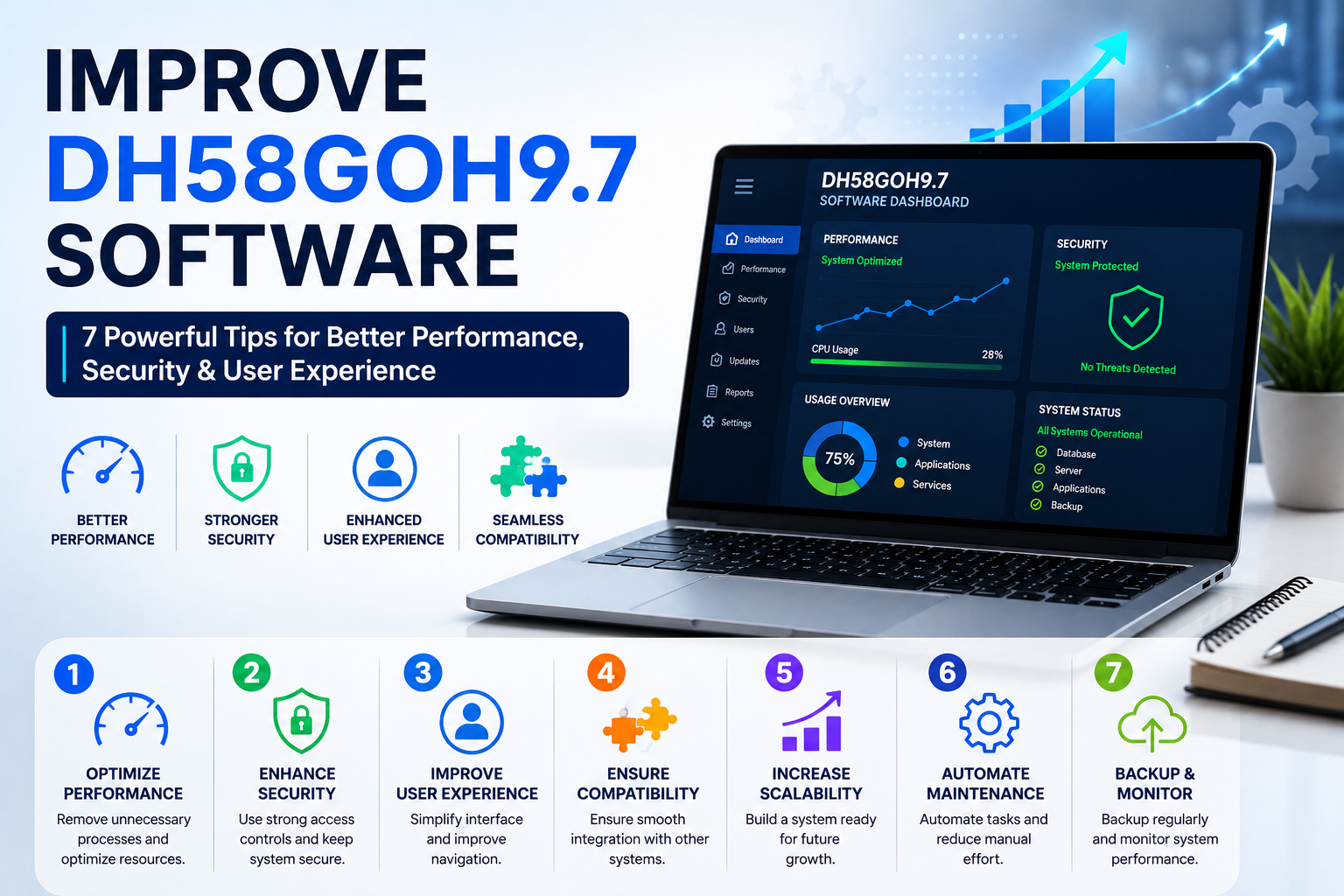
Software performance plays an important role in productivity, reliability, and user satisfaction. When a software platform becomes slow, difficult to use, unstable, or outdated, even simple tasks can take more time than necessary. This is why users and developers need practical strategies to Improve DH58GOH9.7 Software and maintain a smooth digital experience.
DH58GOH9.7 is a software identifier that has attracted attention from users interested in performance optimization, usability, security, compatibility, and long-term maintenance. Because software environments change over time, improving an existing system should not be limited to fixing one particular problem. A better approach is to evaluate the complete platform and identify areas where performance and reliability can be improved.
In this guide, we will explore practical ways to Improve DH58GOH9.7 Software, from optimizing system resources and improving the user interface to strengthening security, compatibility, scalability, maintenance, and monitoring.
What Does DH58GOH9.7 Software Mean?
DH58GOH9.7 appears to be a version or software identifier rather than a widely documented mainstream software product. Public information about the exact implementation is limited, so it is important not to assume a specific architecture, operating system, or feature set without documentation from the software provider.
The general principles for improving DH58GOH9.7 are therefore based on established software optimization practices. These include reducing unnecessary resource usage, keeping software components updated, improving the interface, monitoring errors, strengthening security, and making the system easier to maintain.
The original discussion of the software also emphasizes five important dimensions: performance, user experience, security, compatibility, and scalability.
Why Improve DH58GOH9.7 Software?
There are many reasons to invest time in software improvement. A system that works today may become less efficient as the amount of data, number of users, integrations, and workloads increase.
Improving the software can help address issues such as:
- Slow response times
- Unnecessary background processes
- Frequent errors
- Poor navigation
- Security weaknesses
- Compatibility problems
- Difficult maintenance
- Increasing resource requirements
- Limited scalability
The goal is not simply to make the software faster. A well-optimized platform should also be secure, reliable, easy to use, compatible with other systems, and prepared for future requirements.
Read more: Zimslapt2154
1. Analyze Current Software Performance
Before attempting to Improve DH58GOH9.7 Software, identify what is actually causing the problem.
Randomly changing settings or rewriting parts of a system can create new issues without solving the original problem. Performance analysis provides a better starting point.
Begin by monitoring important areas such as CPU usage, memory consumption, storage activity, network requests, application response time, and error frequency.
Logging and diagnostic tools can help identify processes that are consuming excessive resources. Benchmarking can also provide a baseline against which future improvements can be measured.
Identify the Biggest Bottleneck
Not every performance problem has the same cause.
For example, a slow application might be caused by inefficient code, excessive database queries, insufficient memory, network latency, or unnecessary background tasks.
Once the bottleneck is identified, developers can focus their efforts on the area that will produce the greatest improvement.
2. Keep DH58GOH9.7 Updated
One of the simplest ways to Improve DH58GOH9.7 Software is to keep the available software components and dependencies updated.
Updates can include bug fixes, security patches, performance improvements, compatibility changes, and new functionality. Running outdated components may expose the system to known problems and compatibility issues.
However, updates should not be installed blindly.
Before applying a major update, create a backup and test the update in a controlled environment when possible. This makes it easier to identify compatibility problems before they affect an important production environment.
Create a Simple Update Routine
A useful maintenance routine can include:
- Checking for available updates.
- Reviewing the release information.
- Creating a backup.
- Testing important features.
- Applying the update.
- Monitoring the system after installation.
This approach makes software maintenance more predictable and reduces the risk of unexpected downtime.
3. Optimize System Resources
Resource management is another important part of improving software performance.
Unnecessary background processes can consume CPU cycles and memory. If the system is under heavy load, these processes may reduce responsiveness.
Start by identifying tasks that are not required. Remove unnecessary services where appropriate and optimize resource-intensive processes.
Memory management is particularly important for applications that handle large amounts of information. Developers should look for memory leaks, unnecessary objects, repeated calculations, and inefficient data handling.
Read more: PressVibePulse.com
Reduce Unnecessary Processing
Efficient software should avoid doing the same work repeatedly when the result can be reused.
Caching, efficient data structures, optimized queries, and appropriate processing strategies can reduce unnecessary computation.
The original Techy Flavors article similarly recommends closing unnecessary background applications and allocating system resources appropriately.
4. Improve the User Interface
Performance is important, but user experience is equally valuable.
A technically powerful system can still frustrate users if navigation is confusing or important features are difficult to find.
To Improve DH58GOH9.7 Software, review the interface from the user’s perspective.
Ask simple questions:
- Can users find important features quickly?
- Are menus organized logically?
- Are buttons and labels easy to understand?
- Is the interface consistent?
- Are error messages helpful?
- Does the layout work across different screen sizes?
A clean interface can reduce the learning curve and help users complete tasks more efficiently.
5. Make Navigation Simple and Consistent
Navigation should follow a predictable structure.
Similar functions should be grouped together, frequently used options should be easy to access, and unnecessary menu layers should be avoided.
Consistency is also important. Buttons, icons, colors, terminology, and page layouts should follow a recognizable design system.
When users do not have to learn a different interface for every section of the software, they can work more efficiently.
6. Collect User Feedback
One of the best ways to discover usability problems is to ask actual users.
Developers sometimes focus heavily on technical performance while overlooking small interface problems that users encounter every day.
Feedback can be collected through surveys, support tickets, usability testing, interviews, or built-in feedback forms.
Look for repeated complaints rather than focusing on isolated opinions.
If many users report that a particular workflow is confusing, that area deserves attention.
The source article also highlights feedback collection and customizable workflow options as useful approaches for improving user satisfaction.
7. Strengthen DH58GOH9.7 Security
Security should be treated as an essential part of software improvement rather than an optional feature.
A system can have excellent performance and usability but still create serious problems if sensitive information is not properly protected.
To Improve DH58GOH9.7 Software, review authentication, authorization, encryption, access controls, logging, backups, and vulnerability management.
Use Strong Access Controls
Users should receive only the permissions they actually need.
This principle, often called least privilege, reduces the potential impact of compromised accounts.
Administrative privileges should be limited to authorized personnel, while regular users should receive appropriate permissions for their responsibilities.
Protect Sensitive Information
Sensitive information should be protected both during transmission and when stored.
Encryption can help reduce the risk of unauthorized access if data is intercepted or exposed.
Security configurations should also be reviewed regularly because threats and software environments change over time.
8. Perform Regular Security Audits
Security is not something that can be completed once and forgotten.
Regular assessments can identify outdated components, weak configurations, unnecessary permissions, and other potential vulnerabilities.
A security review may include:
- Checking software dependencies
- Reviewing user permissions
- Examining authentication settings
- Monitoring suspicious activity
- Scanning for vulnerabilities
- Reviewing security logs
- Testing backup recovery
The goal is to identify weaknesses before they become major incidents.
9. Improve Compatibility
Modern software rarely operates in isolation.
It may need to communicate with databases, APIs, cloud services, hardware devices, browsers, operating systems, or third-party applications.
Compatibility should therefore be considered when you Improve DH58GOH9.7 Software.
Before introducing a new integration, test how it affects existing functions. Documentation should clearly explain supported versions, requirements, and connection methods.
Use APIs Where Appropriate
Well-designed APIs can make it easier for software to communicate with external platforms.
Instead of creating complicated custom connections for every integration, a structured API approach can improve maintainability and make future integrations easier.
Compatibility testing should also be performed after major updates to ensure existing integrations continue working correctly.
10. Make the Software More Scalable
Scalability becomes important when the number of users, transactions, files, or data records increases.
A system that performs well with a small workload may struggle when demand increases significantly.
To improve scalability, developers should identify resource limits and design the software so that workloads can be handled efficiently.
Database optimization, caching, efficient queries, load management, and appropriate infrastructure can all contribute to better scalability.
Plan for Future Growth
Do not optimize only for today’s workload.
Consider how the system might be used six months or several years from now. Future planning can reduce the need for expensive redesigns later.
Scalability is particularly important for organizations that expect more users or larger datasets over time.
11. Use Monitoring and Diagnostics
Continuous monitoring makes it easier to detect problems early.
Instead of waiting for users to report that the software has become slow, monitoring systems can identify unusual CPU usage, memory spikes, errors, failed requests, and other warning signs.
Useful metrics may include:
- Response time
- Error rate
- CPU utilization
- Memory usage
- Database performance
- Network latency
- System availability
Monitoring becomes even more useful when alerts are configured for critical thresholds.
12. Maintain Regular Backups
Backups are essential before major software updates, configuration changes, migrations, or testing.
A backup provides a recovery option if an update causes unexpected problems or important information becomes unavailable.
A strong backup strategy should consider:
- What data needs to be backed up
- How frequently backups should occur
- Where backups should be stored
- How long backups should be retained
- How quickly data can be restored
Most importantly, backups should occasionally be tested. A backup that cannot be restored when needed does not provide much protection.
13. Automate Repetitive Maintenance
Automation can make software maintenance more efficient.
Routine tasks such as log analysis, backups, testing, monitoring, dependency checks, and deployment can often be automated.
Automation reduces the amount of manual work and helps make processes more consistent.
For example, an automated monitoring system can notify administrators when performance drops below an expected level. Automated testing can also identify regressions after software changes.
The original article discusses automation as a way to identify resource problems and support proactive maintenance.
14. Test Every Major Improvement
After making changes, testing is essential.
A software improvement should not be considered successful simply because one problem has disappeared. The change should also be checked to make sure it has not created another problem.
Different types of testing may be useful, including:
- Functional testing
- Performance testing
- Security testing
- Compatibility testing
- Usability testing
- Regression testing
Testing should focus particularly on the features most important to users.
Common Mistakes to Avoid
While trying to Improve DH58GOH9.7 Software, avoid making too many changes at once.
Changing multiple components simultaneously makes it difficult to determine which modification helped or caused a problem.
Another common mistake is ignoring security while focusing only on speed.
A fast but insecure application is not a successful optimization.
It is also important to avoid unnecessary features. Adding more functionality does not automatically improve software. Every feature should provide a clear benefit to its users.
Finally, never skip backups before major changes.
A Practical DH58GOH9.7 Improvement Checklist
For a structured approach, follow this basic checklist:
- Analyze current performance.
- Identify major bottlenecks.
- Update supported software components.
- Remove unnecessary resource usage.
- Improve interface consistency.
- Collect user feedback.
- Strengthen authentication and access controls.
- Protect sensitive data.
- Review integrations and compatibility.
- Plan for increased workloads.
- Monitor important performance metrics.
- Maintain reliable backups.
- Automate repetitive maintenance.
- Test every major change.
- Document important configurations and procedures.
Following these steps creates a more organized approach to software improvement instead of relying on trial and error.
Benefits of Improving DH58GOH9.7 Software
A well-planned optimization strategy can provide several benefits.
Better Performance
Reducing unnecessary processing and improving resource management can make software more responsive.
Improved User Experience
Simpler navigation and a cleaner interface can help users complete tasks more efficiently.
Stronger Security
Regular security reviews and updates can reduce exposure to vulnerabilities.
Better Compatibility
Proper integration practices make it easier for the software to work with other systems.
Greater Scalability
Efficient architecture helps the platform handle increasing workloads.
Easier Maintenance
Documentation, monitoring, automation, and testing make long-term maintenance more manageable.
Final Thoughts on Improve DH58GOH9.7 Software
The best way to Improve DH58GOH9.7 Software is to take a complete approach rather than focusing on a single performance issue.
Start by understanding the current system and identifying its biggest bottlenecks. Then improve resource management, update supported components, refine the user experience, strengthen security, review compatibility, and prepare the system for future growth.
Regular monitoring, backups, testing, and automation can make these improvements easier to maintain over time.
Because publicly available information about the exact DH58GOH9.7 implementation is limited, users should always verify technical details against official documentation or the documentation supplied with their particular software environment.
Ultimately, software improvement is an ongoing process. A platform that is regularly monitored, tested, secured, and optimized is more likely to remain reliable and useful as user expectations and technical requirements change.
If your goal is to make DH58GOH9.7 faster, easier to use, safer, and more adaptable, focusing on performance, user experience, security, compatibility, scalability, and maintenance provides a strong foundation for long-term improvement.
