
Introduction
The modern food industry depends on accurate product identification, reliable documentation, effective quality control, and transparent information. From packaged groceries to commercial food production, businesses use different labels, numbers, reference codes, and digital records to organize products and maintain traceability. However, an unfamiliar identifier can create confusion when its purpose is not clearly explained.
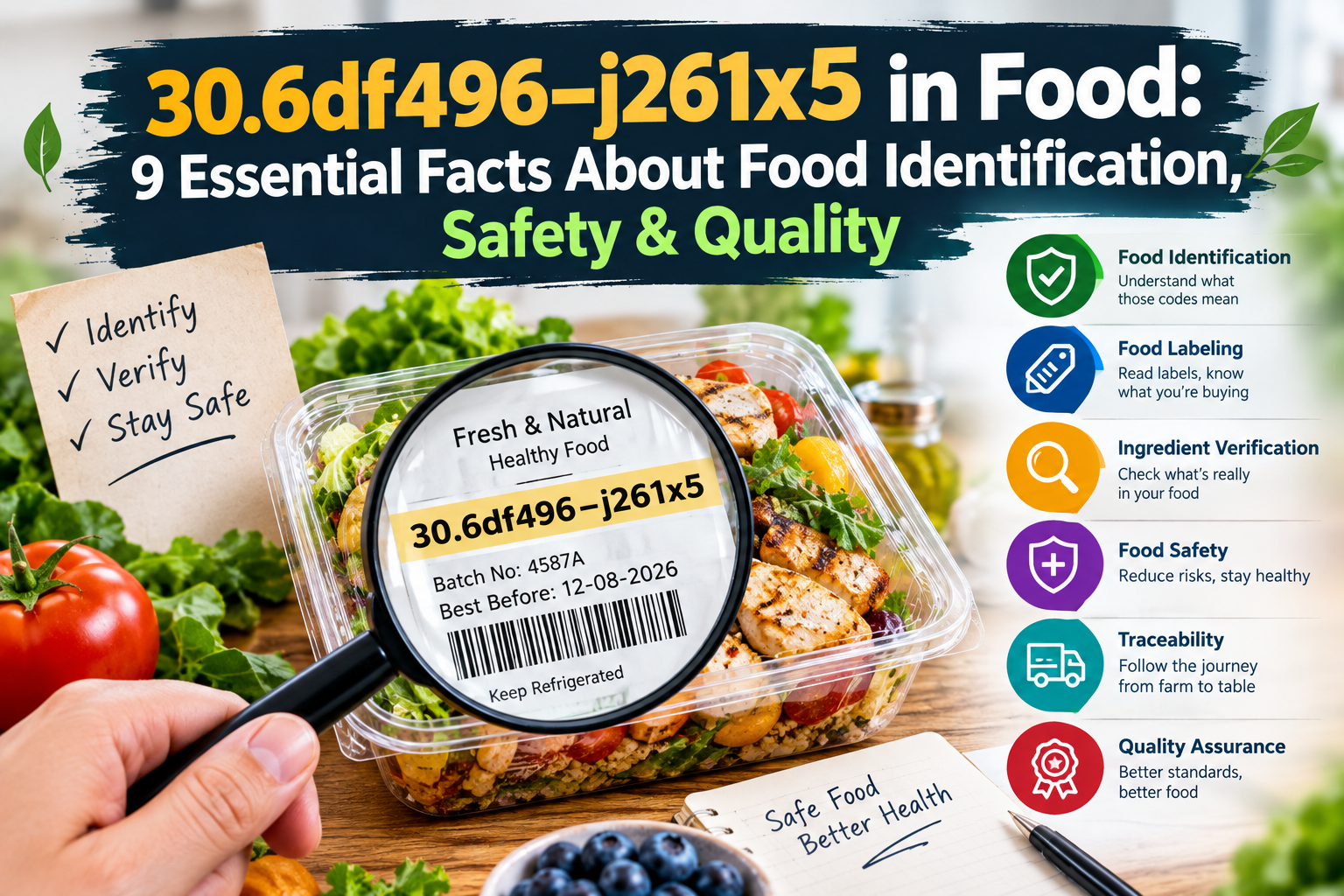
The phrase 30.6df496–j261x5 in food raises questions about whether an unusual code relates to a product label, ingredient record, manufacturing process, laboratory sample, or digital inventory system. Its appearance alone does not confirm any particular meaning. To understand it correctly, readers need information about the original source and the system in which the identifier appears.
This guide explores nine important areas of food identification, including ingredient verification, packaging information, quality assurance, traceability, digital records, and responsible research. It also provides a practical framework for consumers and food businesses that need to investigate unfamiliar codes without relying on unsupported assumptions.
1. Understanding the Purpose of Food Identification Codes
Food identification codes help businesses distinguish products, batches, samples, and records. Depending on the system, an identifier may connect a physical item with manufacturing information, supplier documentation, inventory records, or laboratory results.
When investigating 30.6df496–j261x5 in food, the first step is to determine where the identifier was found. A code printed on packaging may serve a different purpose from a reference appearing in a technical report or an internal company database.
Different Types of Food Identifiers
Several types of identifiers may appear throughout the food supply chain:
- Batch and lot numbers: Help identify products associated with a particular production run.
- Product codes: Distinguish one product or variation from another.
- Barcodes: Support product identification and retail inventory operations.
- Laboratory sample numbers: Connect samples with testing records and results.
- Internal references: Help businesses organize information within their own systems.
These examples illustrate why 30.6df496–j261x5 in food should not automatically be described as a recognized ingredient, chemical substance, or safety certification.
Why Context Is Essential
A code’s format does not reliably reveal its meaning. The manufacturer, supplier, laboratory, or software platform that created the identifier is usually the most appropriate source for clarification.
2. Food Labels and Consumer Understanding
Food labels help consumers understand what they are buying and how to handle a product. Depending on the product and applicable regulations, labels may include ingredients, allergens, nutrition information, net quantity, storage instructions, date markings, and manufacturer details.
For readers researching 30.6df496–j261x5 in food, examining the complete product label can provide more useful information than viewing an isolated code. Nearby text may identify the product, name the manufacturer, or provide a reference for customer support.
Information Worth Checking
Consumers should examine the ingredient list, allergen declarations, storage instructions, packaging condition, and relevant dates. These details can help them assess whether the product matches their needs and whether additional clarification is necessary.
A batch number should not be confused with a nutritional claim. Likewise, an unfamiliar identifier does not independently demonstrate that a product is approved, contaminated, or safe.
Avoiding Incorrect Interpretations
When 30.6df496–j261x5 in food appears on a label or in an online description, do not assume it represents a food additive or a chemical formula. First establish whether the identifier belongs to the product itself, its packaging, or another record.
3. Ingredient Verification and Product Composition
Understanding what a food contains requires reliable ingredient information. Packaged foods may contain raw ingredients, flavorings, preservatives, colors, processing aids, or other components, depending on the product and applicable requirements.
Research involving 30.6df496–j261x5 in food should therefore distinguish between an identifier and an actual ingredient name. Without supporting documentation, the code cannot establish a substance’s chemical identity, nutritional value, permitted use, or possible health effects.
How to Verify an Ingredient
Start with the manufacturer’s official product information and the ingredient list printed on the packaging. If the code appears in a technical document, contact the responsible supplier and request an explanation.
For commercial ingredients, relevant documentation may include:
- Product specifications.
- Technical data sheets.
- Certificates of analysis, where applicable.
- Ingredient declarations.
- Relevant regulatory documentation.
The appropriate document depends on the material and its intended use.
Check Regulatory Requirements
An ingredient’s appearance in a document does not automatically mean it is permitted in every food category or country. Requirements may vary according to the substance, intended use, concentration, and jurisdiction.
If 30.6df496–j261x5 in food is presented as evidence of a particular ingredient or regulatory status, request documentation that directly supports that interpretation.
4. Food Traceability Across the Supply Chain
Traceability allows relevant information about a food product to be followed through production, processing, storage, and distribution. It can help businesses investigate quality concerns, identify affected batches, and manage product recalls.
In many systems, identifiers connect records from different stages of the supply chain. For example, a finished product may be linked to an ingredient shipment, production date, packaging line, warehouse location, and distribution record.
How Traceability Works
Imagine that a food manufacturer discovers a possible problem with a shipment of raw ingredients. If its records connect ingredient lots with finished products, the business can identify which batches may require investigation.
This process can make a response more targeted and improve communication between suppliers, manufacturers, retailers, and relevant authorities.
The role of 30.6df496–j261x5 in food within such a process can only be established if the relevant traceability system defines the identifier and links it to documented records.
Benefits of Reliable Records
Well-maintained traceability information supports inventory management, supplier accountability, quality investigations, and recall procedures. Its effectiveness depends on accurate records, consistent identifiers, and appropriate access to information.
An unexplained code, by itself, is not proof that a product has been traced or certified.
5. Food Safety and Quality Assurance
Food safety programs are designed to identify hazards and reduce the risk of contamination. Potential hazards may be biological, chemical, or physical, and suitable controls depend on the product, processing environment, and handling conditions.
Investigating 30.6df496–j261x5 in food should not begin with the assumption that the identifier signals a particular hazard. Instead, the investigation should focus on verifiable information about the product and its circumstances.
Biological Hazards
Certain bacteria, viruses, and parasites can contaminate food. Appropriate hygiene, safe handling, suitable cooking practices, and temperature control can help reduce relevant risks.
Chemical Hazards
Chemical concerns may involve cleaning residues, contaminants, or substances used incorrectly during production. Product-specific evidence and appropriate testing are more informative than an unexplained code.
Physical Hazards
Foreign objects such as glass fragments, metal pieces, or hard plastic may create physical risks. Food businesses use preventive controls and inspection procedures to reduce these possibilities.
The Importance of Documentation
Quality assurance records can document inspections, corrective actions, supplier checks, and test results. When 30.6df496–j261x5 in food appears in such records, its meaning should be confirmed through the organization’s documented procedures.
6. Digital Identification in the Food Industry
Digital technology has changed how food businesses manage product information. Inventory platforms, supplier databases, laboratory systems, and manufacturing software can store identifiers and connect them with detailed records.
However, 30.6df496–j261x5 in food should not automatically be classified as a digital tracking code simply because it contains letters, numbers, and punctuation. The system that uses it must confirm its purpose.
Inventory Management
Digital inventory systems can record quantities, product references, storage locations, and stock movements. Accurate records can help staff locate products and identify discrepancies.
Laboratory Records
Food laboratories may assign identifiers to samples so that results remain connected to the correct specimen. Accurate sample identification is important because a laboratory result cannot be interpreted properly if its source is uncertain.
Preventing Data Errors
Small differences in spelling, punctuation, or character order can lead to incorrect matches between records. Businesses should preserve identifiers exactly as supplied and document any approved changes.
When working with 30.6df496–j261x5 in food, maintaining the original spelling is particularly important if the identifier must be checked against a database or technical document.
7. Storage Conditions, Packaging, and Dates
Food quality and safety may depend on storage conditions, packaging integrity, handling practices, and time. Different products have different storage requirements, so consumers should follow the instructions provided for the particular food.
If 30.6df496–j261x5 in food appears near a date or storage instruction, examine the surrounding information before interpreting it. The code should not automatically be treated as an expiration date, temperature measurement, or storage recommendation.
Understanding Date Information
Depending on the product and local rules, packaging may include date markings related to quality or recommended consumption periods. Consumers should interpret these markings according to the label and applicable guidance.
Inspecting Packaging
Damaged seals, leaking containers, unusual swelling, or signs of improper storage may justify additional caution. A printed identifier cannot independently establish that a product remains safe.
If the product cannot be identified or a safety concern remains unresolved, contact the manufacturer or an appropriate food-safety authority before consuming it.
8. Responsible Online Research and Verification
Online searches can help people discover information about unfamiliar food-related terms. However, repeated statements across websites do not necessarily establish that a claim is accurate, particularly when multiple pages rely on the same unsupported source.
A careful review of 30.6df496–j261x5 in food should prioritize original documentation, identifiable publishers, and evidence that directly explains the code.
Prefer Reliable Sources
Useful sources may include the manufacturer’s official website, product packaging, supplier specifications, laboratory reports, or publications from the relevant food-safety authority.
Check whether a source explains how its conclusion was reached. A page that assigns a health benefit, toxicity level, ingredient identity, or regulatory status without supporting evidence should be treated cautiously.
Separate Facts From Assumptions
When 30.6df496–j261x5 in food appears in an article or social media post, distinguish the author’s explanation from information that can be independently confirmed.
A responsible research process acknowledges uncertainty rather than filling gaps with guesses. This is especially important when food safety, allergies, or consumer health may be affected.
9. A Practical Checklist for Consumers and Businesses
A structured checklist can help people investigate unfamiliar identifiers efficiently. It also provides a consistent process for communicating with manufacturers, suppliers, laboratories, and quality teams.
Step 1: Record the Original Identifier
Copy the code exactly as it appears. Preserve its punctuation, capitalization, spacing, and surrounding text. A photograph or screenshot can help retain the original context.
Step 2: Identify the Source
Determine whether the identifier comes from a package, supplier document, laboratory report, inventory platform, or website.
Step 3: Contact the Responsible Organization
Ask the manufacturer, supplier, laboratory, or system administrator to explain the code. Request supporting documentation if the answer affects product identification or safety.
Step 4: Match the Relevant Records
Check the product name, batch or lot number, supplier, and dates. Do not assume that two similar-looking codes refer to the same product.
Step 5: Review the Evidence
Compare the explanation with the relevant product specification, label, test record, or official guidance.
Step 6: Document the Result
Keep the explanation, source, verification date, and any follow-up action. If the meaning remains uncertain, record that uncertainty instead of inventing an explanation.
Following these steps when researching 30.6df496–j261x5 in food can help reduce confusion and improve the quality of the final conclusion.
Read more: 0.6 450W Lamp MIP Meaning Explained | Industrial Lighting Code Guide
Frequently Asked Questions
What does 30.6df496–j261x5 in food mean?
The phrase alone does not establish a recognized food ingredient, additive, nutritional component, or safety certification. Its meaning must be confirmed through the original source or the organization that uses the identifier.
Is this code a food additive?
There is insufficient information to identify it as a food additive. Check the product’s ingredient list and request clarification from the manufacturer or supplier.
Can an unfamiliar food identifier prove contamination?
No. An unfamiliar identifier does not independently demonstrate contamination. Relevant evidence may include product-specific findings, inspection records, or appropriate laboratory testing.
How can I verify an unfamiliar food code?
Start with the complete product label, identify the source of the code, and consult the manufacturer or supplier. If a safety concern remains, seek guidance from the relevant food-safety authority.
Conclusion
Accurate identification, clear labeling, traceability, and reliable documentation are essential parts of modern food systems. They help consumers understand products and allow businesses to organize records, investigate quality concerns, and communicate important information throughout the supply chain.
Anyone researching 30.6df496–j261x5 in food should begin by locating the original source, checking the surrounding context, and requesting a documented explanation. An unfamiliar code should never be treated as proof of an ingredient, health effect, safety status, or regulatory approval without supporting evidence.
By combining careful observation with reliable verification, consumers and food businesses can make more informed decisions. The most important principle is simple: establish the source, check the evidence, preserve accurate records, and clearly distinguish confirmed information from assumptions.
