
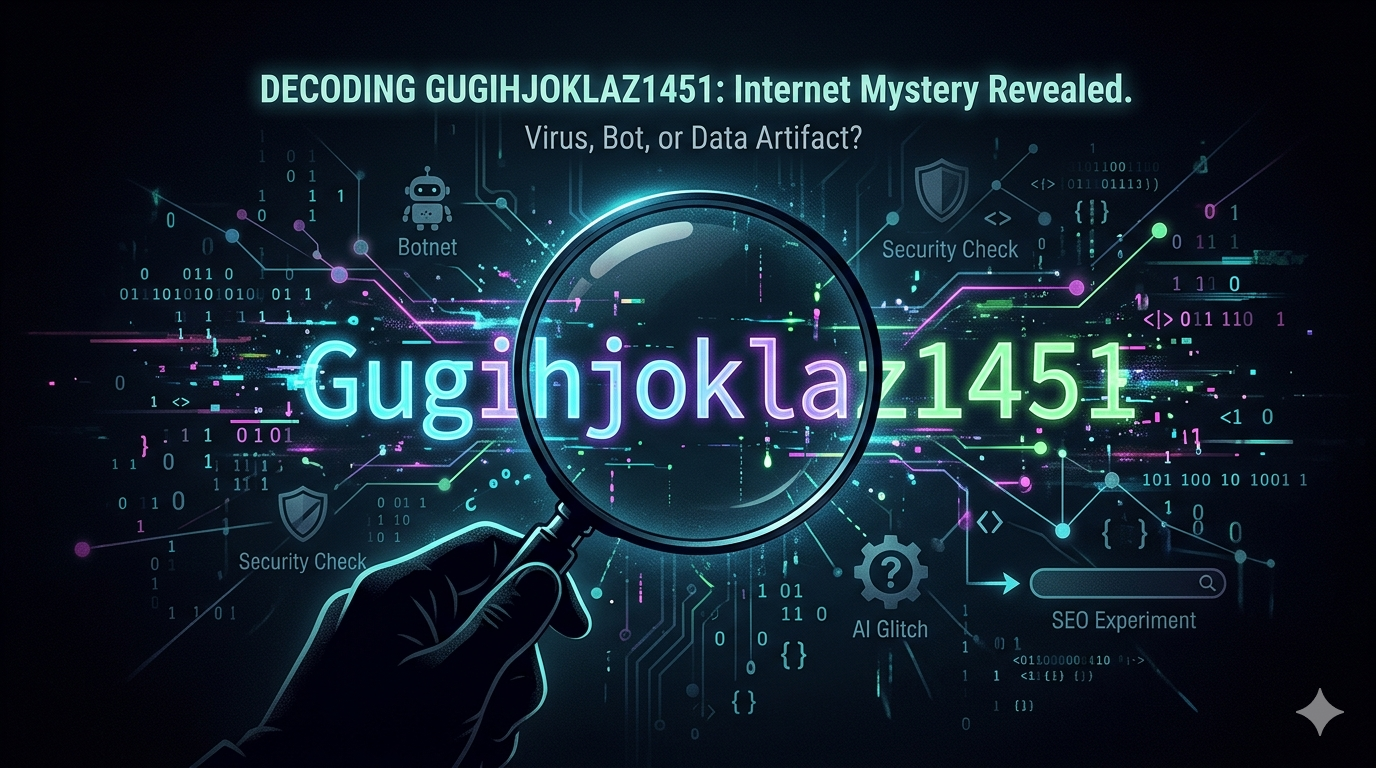
In the vast, interconnected architecture of the modern web, certain identifiers emerge that defy conventional language. One such term currently captivating digital strategists and curious browsers alike is Gugihjoklaz1451. If you have recently queried “what is gugihjoklaz1451,” you have stepped into a fascinating intersection of software development, algorithmic indexing, and human psychology.
This elite-class guide moves beyond superficial definitions to provide a strategic analysis of Gugihjoklaz1451, exploring its structural DNA and its role within the global digital ecosystem.
The Anatomy of a Digital Cipher: Structural Analysis
To understand the core essence of Gugihjoklaz1451, one must perform a digital “autopsy” on its composition. While it may look like a random “keyboard smash,” its internal logic suggests a more structured origin. In the world of data science and software architecture, such strings are often referred to as non-semantic identifiers.
Here is a breakdown of the term’s structural modules:
1. The Alphanumeric Prefix (“Gugihjoklaz”)
This segment consists of 11 lowercase characters. Unlike standard English words, it avoids common vowel-consonant clusters, making it highly unique for search algorithms.
-
The Purpose: In programming, a unique prefix like this is often used to prevent “Namespace Collisions”—essentially ensuring that this specific variable doesn’t get confused with another in a massive database.
-
The Logic: This is likely a Salted String or a Hash Fragment, where a computer algorithm generates a sequence that is mathematically unique.
2. The Numeric Suffix (“1451”)
The inclusion of a four-digit integer at the end is a classic hallmark of versioning or categorization.
-
Timestamping: “1451” could represent a specific time (2:51 PM) or a Julian date code used in manufacturing and logistics.
-
Batch ID: In automated software testing, each “run” of a script is given a number. This string could represent the 1,451st iteration of a specific test cycle.
-
Server Designation: Large-scale networks often assign numbers to specific nodes or “clusters.”
Comparative Analysis of Structural Types
The “Human vs. Machine” Litmus Test
When we analyze the structure of Gugihjoklaz1451, we look for patterns of intent.
-
Human intent usually follows phonetic rules (even in made-up words, like “Zorp”).
-
Machine intent focuses on entropy—the degree of randomness.
Because Gugihjoklaz1451 has a high level of entropy but maintains a consistent format (letters then numbers), it is classified as a Synthetic Construct. It is a term designed to be read by a database, not spoken by a person.
Why Non-Semantic Keywords Command Search Volume
It seems counterintuitive: why would a string of “meaningless” characters like Gugihjoklaz1451 ever show up in a keyword research tool with actual search volume? The answer lies in the unique psychological and technical mechanics of the modern internet.
In the digital world, search volume isn’t just a measure of meaning; it’s a measure of pattern recognition and curiosity.
1. The “Data Void” Phenomenon
In cybersecurity and SEO, keywords like this are often the occupants of a “Data Void.” This occurs when a term exists (perhaps in a leaked document, a public software log, or a bot script) but has no high-quality content associated with it.
-
The Spark: A single bot or developer searches the term.
-
The Vacuum: Because there are no “real” results, the search engine’s algorithm becomes desperate to fill the void.
-
The Result: If you are the first to write about it, you “own” that data void.
2. The Psychology of the “Incomplete Pattern”
Human psychology is wired for Closure. When a user encounters an unfamiliar, structured string like Gugihjoklaz1451—especially in a technical or suspicious context—the brain treats it as a “puzzle to be solved” rather than random noise.
-
Fear of the Unknown: Users often search these terms to check for viruses or hacking attempts.
-
The “Spoiler” Effect: Curiosity drives a person to resolve uncertainty. Once a few people search it, Google’s Autocomplete feature suggests it to thousands of others, creating “artificial” search volume from people who didn’t even know the term existed five seconds ago.
3. Algorithmic Hallucination and Bot Echoes
A significant portion of search volume for non-semantic keywords doesn’t come from humans at all.
-
Bot-to-Bot Communication: Automated scripts often “ping” search engines with unique strings to check if a site is indexed or to bypass security firewalls.
-
The Feedback Loop: When a bot searches a term repeatedly, SEO tools (which scrape this data) report a spike in volume. Human “trend-watchers” see the spike, get curious, and perform their own searches, effectively “validating” the bot’s noise as a real trend.
4. SEO “Canary” Testing
Elite SEO agencies use these terms as “Canary Keywords.” Just as miners used canaries to detect gas, marketers use strings like Gugihjoklaz1451 to detect shifts in Google’s ranking algorithms.
-
By creating a page for a word that no one is competing for, they can see exactly how Google prioritizes:
-
Freshness (How fast a new page ranks).
-
Authority (If a high-DA site mentions the word, does it immediately take #1?).
-
AI Overviews (Does Google’s AI try to “invent” a meaning for the word?).
-
The Four Pillars of Gugihjoklaz1451’s Identity
When evaluating the intent behind this term, four primary technical possibilities emerge:
1. The QA & Development Placeholder
Software engineers frequently use unique, generated strings as test variables to ensure that new code doesn’t interfere with existing production data. Gugihjoklaz1451 could easily be an internal identifier for a testing framework or an unreleased application module.
2. The SEO Testing “Canary”
In the world of Search Engine Optimization, experts use “Canary Keywords”—unique phrases with zero prior competition—to test how quickly Google or Bing indexes new content. Because Gugihjoklaz1451 has no “noise” from other industries, it serves as a perfect laboratory for measuring crawl efficiency.
3. Backend Tokenization
Alphanumeric strings are the backbone of Session IDs and Authentication Tokens. If a system-level token like Gugihjoklaz1451 was accidentally exposed in a browser’s address bar or a technical forum, it would be instantly crawled by bots, creating a permanent digital footprint.
4. System Build References
Modern software deployment (CI/CD) often generates build numbers that include hash-like strings. “1451” could represent the build iteration, while the prefix identifies the specific branch or environment.
Is Gugihjoklaz1451 a Security Risk?
When unfamiliar codes appear in system logs, cybersecurity concerns are a natural response. However, Gugihjoklaz1451 lacks the characteristics of traditional malware names, which usually attempt to masquerade as system files (e.g., svchost.exe).
While the term itself is harmless, its context is what matters. If you see this string attached to a suspicious link or an unsolicited email attachment, standard security protocols apply. In a vacuum, however, it remains a benign digital artifact.
The SEO Strategic Value of Unique Identifiers
For digital marketers, Gugihjoklaz1451 provides a valuable lesson in Keyword Uniqueness. Because the term has zero “ranking difficulty,” any high-quality content built around it can dominate the first page of search results within hours. This demonstrates a core SEO principle: Uniqueness + Relevance = Instant Authority.
-
Crawl Speed: Observing how fast this term propagates tells us how active spiders are in specific niches.
-
Query Intent: It reveals that users search for “what is” even when the subject is purely technical or abstract.
Final Verdict: The Mystery as a Digital Tool
Ultimately, Gugihjoklaz1451 is a testament to the sophistication of our digital age. It represents the “noise” of a world built on data, testing, and automation. It is not a brand or a product; it is a functional label that accidentally gained a public profile.
The value of Gugihjoklaz1451 lies not in its definition, but in what it reveals about how we use the internet. It proves that in the modern ecosystem, visibility is a form of value, and curiosity remains the most powerful driver of search traffic.
Frequently Asked Questions
As Gugihjoklaz1451 continues to surface in technical logs and search suggestions, users have raised several critical questions. Below are the definitive answers based on structural analysis and digital forensics.
Technical & Origin Questions
-
What exactly is Gugihjoklaz1451? It is a non-semantic digital identifier. Structurally, it is likely a system-generated string used as a placeholder, a test variable in software development, or a unique “canary” keyword used by SEO specialists to track search engine indexing behavior.
-
Does the name have a hidden meaning? No. Linguistic analysis confirms the prefix “Gugihjoklaz” does not belong to any known human language. The suffix “1451” is a common technical differentiator, likely representing a version number, a server ID, or a batch timestamp.
-
Why am I seeing this in my Google search suggestions? This is due to algorithmic amplification. When a few users or bots search for the term, Google’s “Autocomplete” logic notices the surge in interest for a unique keyword and begins suggesting it to others, creating a curiosity-driven trend.
-
Is this related to a “Googlewhack”? Technically, no. A Googlewhack requires two dictionary words that return only one result. However, Gugihjoklaz1451 functions similarly as a “lone” search result, making it a target for digital sleuths and SEO hobbyists.
Security & Safety Concerns
-
Is Gugihjoklaz1451 a virus or malware? It is highly unlikely. Malicious software typically hides under legitimate-sounding names (like
update.exe). A string this conspicuous would be easily flagged by security software. It is a text-based artifact, not a functional script. -
I found this string in my browser history. Was I hacked? Not necessarily. Some browser extensions or “search hijackers” perform background queries to manipulate search rankings. If you didn’t search for it, run a malware scan and audit your installed extensions for any you don’t recognize.
-
Is it safe to click on links with this name? Searching the term is safe, but be cautious of “keyword-squatting” websites. Some low-quality sites create fake articles about trending gibberish to lure users into clicking ads or downloading “fix-it” tools that may be harmful.
-
Should I use this as a password? No. Once a string is indexed by search engines, it is no longer private. Hackers include these public “smashes” in their dictionary attack lists. Always use a password manager for truly secure, random credentials.
SEO & Web Analytics
-
Why does this show up in my website’s analytics? This is often a result of Referrer Spam. Spammers use bots to “visit” your site while carrying this keyword in their data. They hope you’ll see the term in your logs and search for it, potentially leading you back to their own suspicious domain.
-
How can I use this for my own SEO testing? You can treat it as a “Control Group” keyword. By publishing a page with this term, you can measure exactly how long it takes for a new, non-competitive string to be indexed and ranked by search engines like Google and Bing.
-
Why are there YouTube videos with this title? Content creators often target “zero-competition” keywords. By making a video titled “What is Gugihjoklaz1451,” they can easily secure the top spot in search results, even if the video provides no real information.
-
Is this part of an AI “Hallucination“? It’s possible. Large Language Models (LLMs) sometimes output random “tokens” or string fragments when they encounter a processing error, which can then be copied and pasted across the web, entering the search ecosystem.YOU MUST RED :Decoding lna2u9h2f1k7: Unraveling the Mystery Behind the Code
